feedzop-word-mark-logo
searchLogin
Feedzop
homeFor YouUnited StatesUnited States
You
bookmarksYour BookmarkshashtagYour Topics
Trending
trending

Jaguars overwhelm Jets 48-20

trending

Myles Garrett nears sack record

trending

Trevor Lawrence shines, 5 TDs

trending

Affleck, Damon crime thriller

trending

NFL playoff picture Week 15

trending

NHL threatens 2026 Olympics

trending

Nick Reiner killed his parents

trending

LeBron James blocks Allen

trending

Snow causes school delays

Terms of UsePrivacy PolicyAboutJobsPartner With Us

© 2025 Advergame Technologies Pvt. Ltd. ("ATPL"). Gamezop ® & Quizzop ® are registered trademarks of ATPL.

Gamezop is a plug-and-play gaming platform that any app or website can integrate to bring casual gaming for its users. Gamezop also operates Quizzop, a quizzing platform, that digital products can add as a trivia section.

Over 5,000 products from more than 70 countries have integrated Gamezop and Quizzop. These include Amazon, Samsung Internet, Snap, Tata Play, AccuWeather, Paytm, Gulf News, and Branch.

Games and trivia increase user engagement significantly within all kinds of apps and websites, besides opening a new stream of advertising revenue. Gamezop and Quizzop take 30 minutes to integrate and can be used for free: both by the products integrating them and end users

Increase ad revenue and engagement on your app / website with games, quizzes, astrology, and cricket content. Visit: business.gamezop.com

Property Code: 5571

Home / Arts and Entertainment / Bayeux Tapestry's 1000-Year Mystery Solved!

Bayeux Tapestry's 1000-Year Mystery Solved!

15 Dec

•

Summary

  • The Bayeux Tapestry was likely created for monks' mealtime reading.
  • Professor Pohl suggests Canterbury's St Augustine's Abbey as origin.
  • The tapestry may have been stored for decades before display.
Bayeux Tapestry's 1000-Year Mystery Solved!

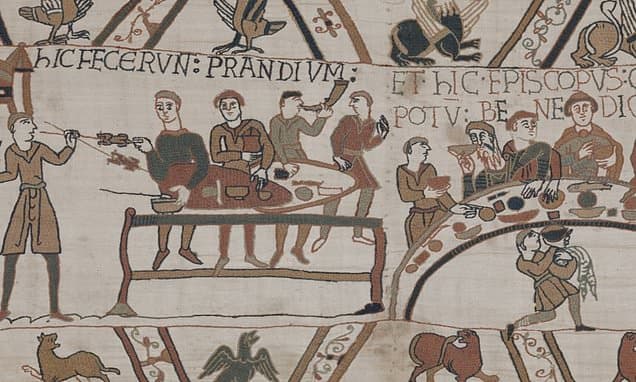
New research suggests the Bayeux Tapestry, a significant medieval artwork, was originally intended for display in the refectory of St Augustine's Abbey in Canterbury, England. Historian Professor Benjamin Pohl posits that the nearly 1,000-year-old masterpiece was designed to provide "mealtime reading" for monks, offering collective reflection and entertainment during meals.

While the tapestry's creation is often dated to the 1080s, possibly at St Augustine's Abbey by skilled embroideresses, its original purpose in England remained a mystery. Professor Pohl's theory indicates it may have been commissioned by Bishop Odo, William the Conqueror's half-brother, but could have been stored for up to 50 years if the refectory's construction was delayed, which indeed occurred.

The tapestry, a 230-foot-long linen embroidery, vividly recounts the events leading to the Norman Conquest of England. This latest hypothesis suggests a new understanding of its initial role, moving beyond its later documented existence in Bayeux Cathedral from 1476.

Disclaimer: This story has been auto-aggregated and auto-summarised by a computer program. This story has not been edited or created by the Feedzop team.
Evidence suggests the Bayeux Tapestry was likely designed and crafted at St Augustine's Abbey in Canterbury, England, in the late 11th century.
A recent theory proposes the Bayeux Tapestry was intended as mealtime reading for medieval monks at St Augustine's Abbey.
The Bayeux Tapestry is first mentioned in written records in 1476, described in an inventory of Bayeux Cathedral.

Read more news on

Arts and Entertainmentside-arrowEnglandside-arrow

You may also like

Golding's Lord of the Flies: A Secret Literary Partnership

9 hours ago • 3 reads

article image

Jerusalem's Ancient Wall Reveals Ceasefire Clue

9 Dec • 22 reads

article image

Pope Leo XIV Prays for Peace at Spanish Steps

8 Dec • 36 reads

article image

King Charles' Sandringham Folly Decked for Festive Magic

9 Dec • 34 reads

article image

From Cow Shed to Royal Smithy: A Welsh Blacksmith's Journey

6 Dec • 50 reads

article image