

Home / Arts and Entertainment / Calder's Art: A Playground for All Ages
Calder's Art: A Playground for All Ages
28 Apr
Summary
- Calder exhibition at Fondation Louis Vuitton celebrates his centenary.
- His kinetic sculptures and mobiles capture childlike wonder.
- Art should be fun, balancing boldness with delicate grace.
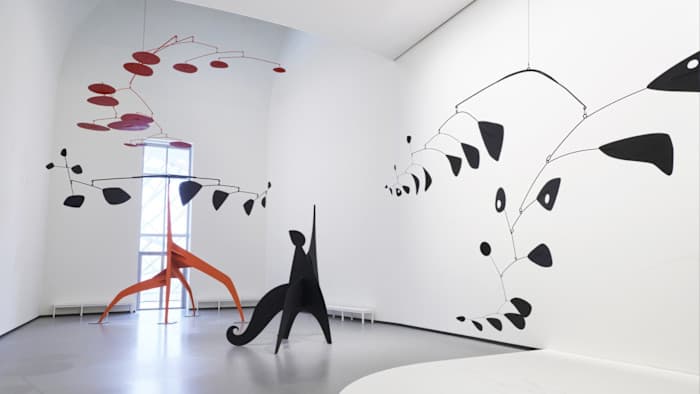
The Fondation Louis Vuitton is hosting 'Calder: Dreaming in Balance,' a significant exhibition marking 100 years since Alexander Calder's arrival in Paris and 50 years since his death. This presentation celebrates his kinetic sculptures and mobiles, which are described as elating, engrossing, and heartwarming, capable of making viewers of all ages feel like children. Calder, trained as an engineer, believed art should be fun and offer new beauty. His works, like the "Arc of Petals" and "Eucalyptus," are lyrical and witty. The exhibition features pieces like "Rouge Triomphant," showcasing the paradox of delicacy within boldness through cut metal forms suspended in a delicate balance. Calder's early work, including brass creations for his parents and his "Cirque Calder," highlights his mechanical ingenuity and playful spirit. His artistic journey, influenced by Piet Mondrian, led to the development of abstract kinetic sculptures, initially motorized and later powered by air currents, earning the name 'mobiles' from Marcel Duchamp. These sculptures evolved, becoming larger and more liberated in form, mastering space with airy, light, and fanciful designs. Monumental postwar works, such as sound pieces and "Blizzard," demonstrate careful engineering left to the whims of air currents. Calder's use of metal aligns him with postwar American optimism and the democratization of culture. His most beloved works from 1945-1960 feature rotating forms that move individually yet affect each other, suggesting freedom, the passage of time, or simply playfulness, with some interpreting them as metaphors for hope and social change.
