Home / Arts and Entertainment / AI Recreates Ancient Roman Beast Hunts
AI Recreates Ancient Roman Beast Hunts
8 Sep
Summary
- AI brings ancient Roman beast hunts to life with reenactments.
- Documentary explores the capture and transport of exotic animals.
- AI aids historical storytelling with unprecedented visual spectacle.
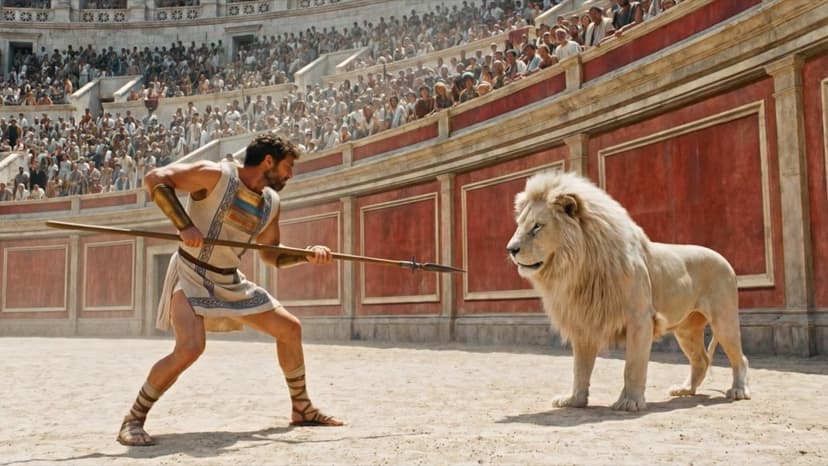
A groundbreaking documentary, "Beasts of the Colosseum," is captivating international audiences with its innovative use of Artificial Intelligence to reconstruct the Venationes of Ancient Rome. Produced in France and associated with Mediaset in Italy, the film has secured distribution deals with ZDF/Terra X in Germany, SVT in Sweden, and Radio-Canada.
The documentary delves into the complex logistics and vast scale of these extraordinary spectacles, where exotic wild beasts, rather than gladiators, were the main attractions. It meticulously details the methods employed to capture and transport thousands of animals from the farthest reaches of the Roman Empire to the arenas.
Christophe Bochnacki, President of Balanga, highlights AI's transformative power in history documentaries. He states that AI enables the visualization of historical worlds previously beyond the economic reach of production, offering viewers an unparalleled immersive experience and visual ambition.
Producer Enora Contant was inspired by the "Gladiator" film's tiger scene, prompting a deeper exploration into the origins of the animals used in Roman games. The film addresses the question of where these creatures came from, a detail often overshadowed by the human participants.
These games were central to Roman social and political life, serving as demonstrations of imperial power and conquest. Wild animals symbolized the untamed world, and their dominance in the arena represented Rome's mastery over nature itself. The documentary features insights from experts like Katia Schörle.
AI was employed for all historical reenactments, including capture expeditions, animal transport, backstage preparations, and arena events. These sequences are built upon thorough historical research, with historians verifying settings, costumes, animals, and actions. The generative AI process requires significant directorial and editing intervention to overcome limitations in continuity and movement.
Contant believes AI will augment, not replace, traditional documentary filmmaking. While it won't supplant directorial vision or investigative journalism, AI provides visual tools that can elevate historical, scientific, and factual storytelling, allowing documentaries to rival fiction in spectacle and immersion.
Surprising historical facts revealed include the existence of specialized fighters called Venatores, who were trained to confront animals, and the significant involvement of the Roman army in animal capture operations. The army utilized its strategic and logistical expertise for this entertainment industry.
Most striking is the ecological impact of this entertainment, with thousands of animals killed over centuries. This led to the extinction of species like the North African elephant, marking one of the earliest known instances of intense wildlife pressure driven purely by entertainment.


