
Home / Technology / AMD CEO's China Visit: A Stark Contrast to Nvidia's
AMD CEO's China Visit: A Stark Contrast to Nvidia's
29 May
Summary
- AMD CEO Lisa Su visited China with a low profile, unlike Nvidia's CEO.
- AMD holds 4% of China's AI chip market, offering diverse products.
- Nvidia's market share in China has effectively dropped to zero.
- AMD promotes its ROCm software stack as an alternative to Nvidia's CUDA.
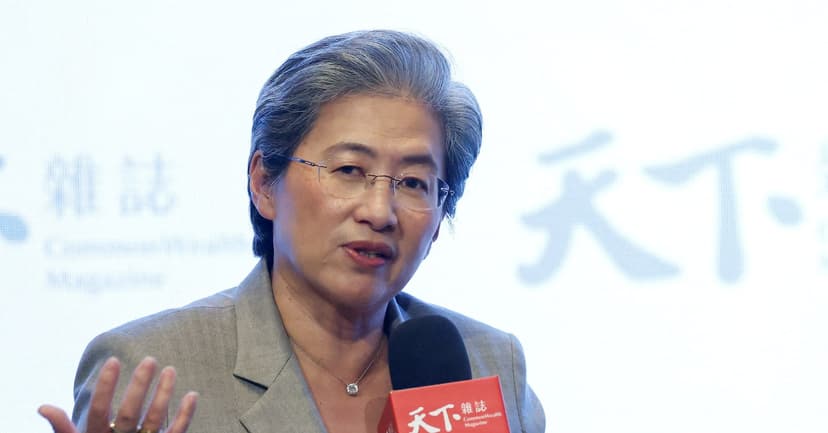
AMD CEO Lisa Su recently concluded a visit to China, maintaining a notably lower profile than her Nvidia counterpart, Jensen Huang. This contrast highlights divergent corporate diplomacy and market fortunes in China's politically sensitive artificial intelligence chip sector. A year ago, Nvidia's market share in China was reported at 50%, a figure that has since fallen to effectively zero due to U.S. export controls and Beijing's drive for self-reliance in advanced AI chips.
In contrast, AMD commands approximately 4% of China's AI chip market. The company offers a wider range of products beyond AI accelerators, including central processing units (CPUs), consumer graphics processing units (GPUs), and programmable integrated circuits (FPGAs). This diverse offering provides AMD access to various system architectures as AI applications expand into broader enterprise use.
During her visit, Su met with Chinese Vice Premier He Lifeng, who welcomed AMD's cooperation. This high-level engagement contrasted with the lack of a comparable senior meeting for Nvidia's Huang. AMD is actively promoting its open-source ROCm software stack in China, seeking to provide an alternative to Nvidia's established CUDA ecosystem, especially as advanced Nvidia hardware becomes difficult to procure.
Despite AMD's efforts, challenges remain. Its software ecosystem is less mature than Nvidia's, and U.S. export controls also limit the sale of AMD's most advanced AI chips to China. Last year, AMD reportedly sold a significant number of AI chips to Alibaba, but adapting them required substantial engineering resources due to software limitations. China accounts for about 20% of AMD's revenue.
