feedzop-word-mark-logo
searchLogin
Feedzop
homeFor YouIndiaIndia
You
bookmarksYour BookmarkshashtagYour Topics
Trending
Terms of UsePrivacy PolicyAboutJobsPartner With Us

© 2026 Advergame Technologies Pvt. Ltd. ("ATPL"). Gamezop ® & Quizzop ® are registered trademarks of ATPL.

Gamezop is a plug-and-play gaming platform that any app or website can integrate to bring casual gaming for its users. Gamezop also operates Quizzop, a quizzing platform, that digital products can add as a trivia section.

Over 5,000 products from more than 70 countries have integrated Gamezop and Quizzop. These include Amazon, Samsung Internet, Snap, Tata Play, AccuWeather, Paytm, Gulf News, and Branch.

Games and trivia increase user engagement significantly within all kinds of apps and websites, besides opening a new stream of advertising revenue. Gamezop and Quizzop take 30 minutes to integrate and can be used for free: both by the products integrating them and end users

Increase ad revenue and engagement on your app / website with games, quizzes, astrology, and cricket content. Visit: business.gamezop.com

Property Code: 5571

Home / Technology / AI Robots Learn, Work, and Adapt Faster Than Ever

AI Robots Learn, Work, and Adapt Faster Than Ever

20 Jan

•

Summary

  • Robots evolve from deterministic machines to adaptive learners.
  • AI allows robots to perform varied, complex tasks in dynamic environments.
  • Cloud computing and accessible tech lower AI robot deployment costs.

AI Robots Learn, Work, and Adapt Faster Than Ever

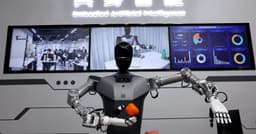
The field of artificial intelligence is rapidly integrating with physical robots, moving beyond fixed, repetitive tasks. Over 4.7 million industrial robots were operational in 2024, with annual growth exceeding 500,000 units. These evolving robots now possess autonomy and hardware to manipulate objects, using sensors to perceive their surroundings.

Robots are learning through observation and trial-and-error, with some now requiring only a single demonstration for a task. They are transitioning from "high-volume, low-variation" environments to dynamic, "high-variation, low-volume" settings. This shift makes their deployment viable for smaller-scale and more complex operations.

Improvements in soft materials, precision motors, and training methods, coupled with accessible processing power and cloud computing, are lowering the cost of advanced AI robots. Intuitive interfaces and natural language communication further simplify deployment, prompting companies to redesign workflows for maximum advantage.

trending

Gold prices hit all-time high

trending

RRB NTPC application status released

trending

2026 Skoda Kushaq unveiled

trending

KEA revises KCET exam dates

trending

Trump Greenland claims market down

trending

Toyota unveils Urban Cruiser Ebella

trending

NDBI Nasdaq ticker reserved

trending

Vivo X200T launching in India

trending

Marizanne Kapp joins London Spirit

While rule-based and training-based systems have limitations, context-based robots leverage generalist foundation models for more flexible responses. These robots can interpret varied inputs and adapt to new situations, though challenges remain in data collection and simulating real-world complexity.

Geographically, Asia, led by China, is a major driver of robot adoption, accounting for 54% of new installations in 2024. Sectors like healthcare are also showing significant growth, with robots assisting in rehabilitation, diagnostics, and elder care.

Despite concerns about job displacement, AI-enabled robots are filling workforce gaps and preventing injuries by assisting humans. The nature of jobs is evolving, with a greater need for technical skills in operating and maintaining robots, rather than purely manual labor.

Disclaimer: This story has been auto-aggregated and auto-summarised by a computer program. This story has not been edited or created by the Feedzop team.
AI robots are transitioning from deterministic machines performing single tasks to adaptive systems capable of learning and handling complex, varied tasks in changing environments.
Increased processing power, cloud computing, and more intuitive interfaces have reduced the need for expensive hardware and simplified deployment, making them more affordable.
Asia, particularly China, is at the forefront of robot installation, making up 54% of new robot deployments globally in 2024.

Read more news on

Technologyside-arrowChinaside-arrowArtificial Intelligence (AI)side-arrow

You may also like

Europe's AI Race: Building Independence

1 day ago • 6 reads

article image

Humanoid Robots: From Labs to Production Lines

17 hours ago • 2 reads

article image

World Richer Than Ever, Yet Deeply Out of Balance

2 Jan • 181 reads

article image

China Tightens AI Personality Rules

28 Dec, 2025 • 139 reads

article image

US bets big on AI, risking future prosperity

14 Dec, 2025 • 250 reads

article image