Home / Technology / AI Agents Demand More: Vector Databases Scale Up
AI Agents Demand More: Vector Databases Scale Up
13 Mar
Summary
- Agentic AI agents require high-volume, rapid information retrieval.
- Purpose-built retrieval infrastructure is crucial for AI agents' success.
- Vector databases are evolving from RAG artifacts to essential AI layers.
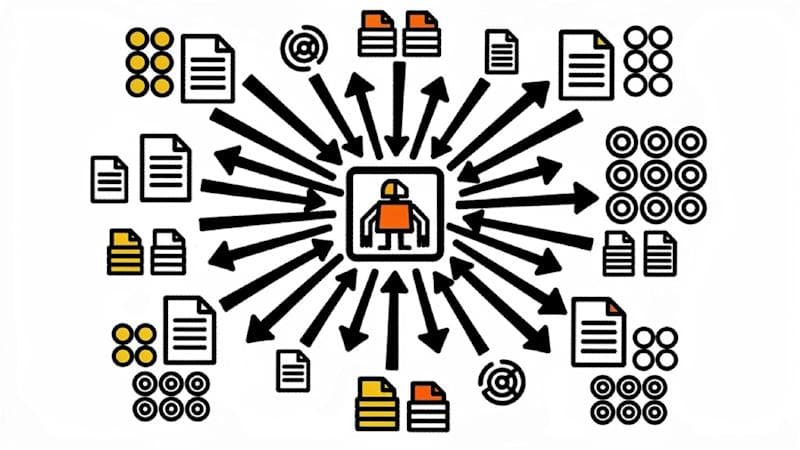
The emergence of agentic AI has intensified the demand for efficient information retrieval, contrary to earlier predictions that vector search would become obsolete. Organizations are realizing that AI agents operate at a scale far exceeding human query rates, necessitating advanced infrastructure to handle thousands of queries per second.
Purpose-built retrieval systems are proving critical, as context windows alone cannot manage the high-recall search and sustained query volumes required by autonomous decision-making. Companies like Qdrant are securing significant funding, signaling the growing importance of specialized vector databases in the AI ecosystem.
This shift highlights that the retrieval problem has scaled up, not shrunk. Failure modes in non-purpose-built retrieval layers can lead to degraded decision quality, relevance issues with fresh data, and latency problems across distributed systems.
New releases from companies like Qdrant address these challenges with features like relevance feedback and delayed fan-out querying. While many databases now offer vector data types, the specialization lies in retrieval quality at production scale, distinguishing search engines from general databases.
Examples from companies like GlassDollar and &AI illustrate this need. GlassDollar migrated from Elasticsearch to Qdrant, cutting costs and improving user engagement, emphasizing that retrieval quality is their core product. &AI built its patent litigation AI agent on Qdrant, prioritizing retrieval as the grounded 'truth' over generation.
The transition to dedicated search infrastructure is driven by factors such as retrieval quality directly impacting business outcomes, complex query patterns, and massive data volumes crossing tens of millions of documents.