Home / Technology / AI Agents Learn Together, Evolve Faster
AI Agents Learn Together, Evolve Faster
19 Feb
Summary
- Researchers developed Group-Evolving Agents (GEA) for adaptable AI.
- GEA enables groups of AI agents to share experiences and improve.
- GEA outperformed human-designed frameworks on coding tasks.
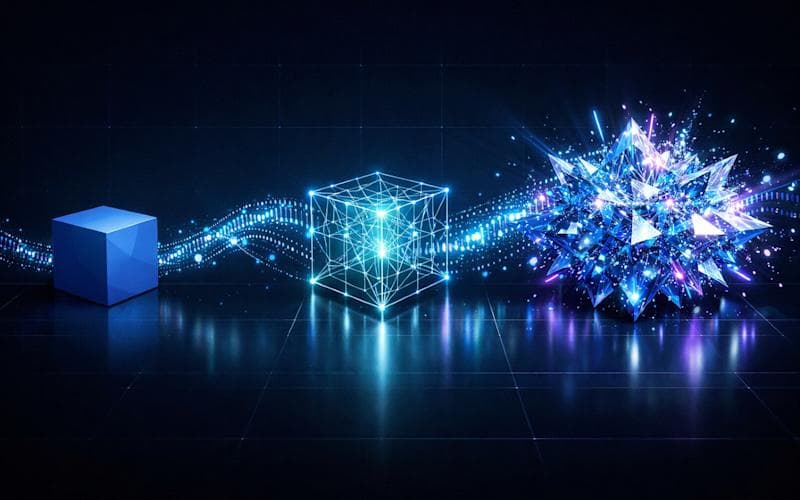
Creating AI agents that can adapt to dynamic environments without constant human intervention remains a significant challenge for enterprise deployment. Today's models are largely static and prone to breaking with simple environmental changes. To overcome this, scientists at the University of California, Santa Barbara, have developed Group-Evolving Agents (GEA), a new framework enabling AI agents to evolve collectively. This approach allows groups of agents to share experiences and reuse innovations, leading to autonomous improvement over time. Experiments on intricate coding and software engineering tasks demonstrated GEA's substantial superiority over existing self-improving frameworks. Notably, the system autonomously evolved agents that matched or surpassed the performance of frameworks painstakingly designed by human experts.
GEA departs from traditional "lone wolf" evolution, which often isolates agent learning in tree-structured lineages. This isolation can lead to valuable discoveries being lost if a specific branch fails. Instead, GEA treats a group of agents as the fundamental unit of evolution, creating a shared pool of collective experience accessible to all members. A "Reflection Module" powered by a large language model analyzes this shared history to identify group-wide patterns and generate "evolution directives." These directives guide the creation of the next generation, ensuring they inherit combined strengths from all parents.
In rigorous benchmarks, GEA demonstrated a significant leap in capability. On SWE-bench Verified, GEA achieved a 71.0% success rate, surpassing the baseline's 56.7%. On Polyglot, GEA reached 88.3% compared to the baseline's 68.3%, highlighting its adaptability across programming languages. Crucially for businesses, GEA's performance on SWE-bench matched that of OpenHands, a top human-designed framework. This suggests a potential reduction in reliance on human prompt engineers for agent framework optimization. The efficiency extends to cost, with inference costs remaining unchanged post-evolution. Furthermore, innovations discovered by GEA agents are more robustly consolidated and propagated, creating "super-employees" with combined best practices. This evolutionary framework is also model-agnostic, meaning learned optimizations transfer even when the underlying AI model is switched.