Home / Science / Universe Ending Soon? New Data Suggests Big Crunch
Universe Ending Soon? New Data Suggests Big Crunch
16 Feb
Summary
- Universe may be halfway through its lifespan of 33 billion years.
- New data suggests a 'big crunch' rather than endless expansion.
- Cosmic collapse is predicted to occur in approximately 20 billion years.
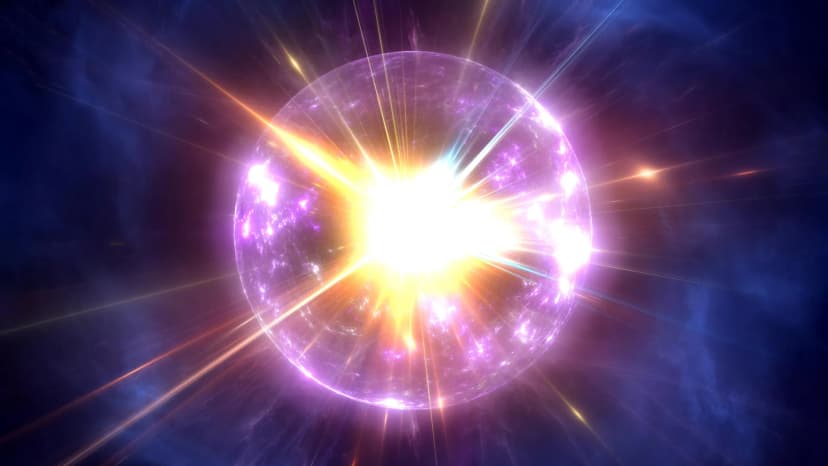
Scientists now project that the universe might be nearing its end, with calculations indicating a potential lifespan of approximately 33 billion years. The cosmos, currently 13.8 billion years old, is estimated to have about 11 billion years of expansion remaining before it reaches its maximum size.
New data from dark energy observatories like DES and DESI suggest a shift from the long-held belief in perpetual expansion. Physicist Henry Tye's updated model indicates that the universe may instead experience a 'big crunch,' a scenario where it reverses direction and collapses into a single point.
This cosmic contraction is predicted to occur in roughly 20 billion years. Tye's research incorporates a hypothetical low-mass particle that influences dark energy's behavior, causing the cosmological constant to effectively become negative. This offers a more complex explanation than a simple constant property of space.
Further observations from projects like DESI, the Zwicky Transient Facility, the Euclid space telescope, NASA's SPHEREx mission, and the Vera C. Rubin Observatory are expected to refine these estimates. Understanding both the beginning and potential end of the universe aids cosmologists in comprehending its complete history.