feedzop-word-mark-logo
searchLogin
Feedzop
homeFor YouIndiaIndia
You
bookmarksYour BookmarkshashtagYour Topics
Trending
trending

Ola promoter offloads shares

trending

KOSPI drops amid AI concerns

trending

Rohit Prasad exits Amazon

trending

SEBI impacts HDFC AMC share

trending

Hindustan Zinc share price climbs

trending

RCB signs Jacob Duffy

trending

UP board exam schedule

trending

KSH International IPO Update

trending

Blundell returns to Black Caps

Terms of UsePrivacy PolicyAboutJobsPartner With Us

© 2025 Advergame Technologies Pvt. Ltd. ("ATPL"). Gamezop ® & Quizzop ® are registered trademarks of ATPL.

Gamezop is a plug-and-play gaming platform that any app or website can integrate to bring casual gaming for its users. Gamezop also operates Quizzop, a quizzing platform, that digital products can add as a trivia section.

Over 5,000 products from more than 70 countries have integrated Gamezop and Quizzop. These include Amazon, Samsung Internet, Snap, Tata Play, AccuWeather, Paytm, Gulf News, and Branch.

Games and trivia increase user engagement significantly within all kinds of apps and websites, besides opening a new stream of advertising revenue. Gamezop and Quizzop take 30 minutes to integrate and can be used for free: both by the products integrating them and end users

Increase ad revenue and engagement on your app / website with games, quizzes, astrology, and cricket content. Visit: business.gamezop.com

Property Code: 5571

Home / Science / Titan's Ocean Mystery: Ice and Slush Instead?

Titan's Ocean Mystery: Ice and Slush Instead?

17 Dec

•

Summary

  • Titan may have deep ice and slush layers, not a global ocean.
  • Pockets of liquid water exist within Titan's icy interior.
  • Cassini data suggests a 15-hour gap in gravitational pull effects.
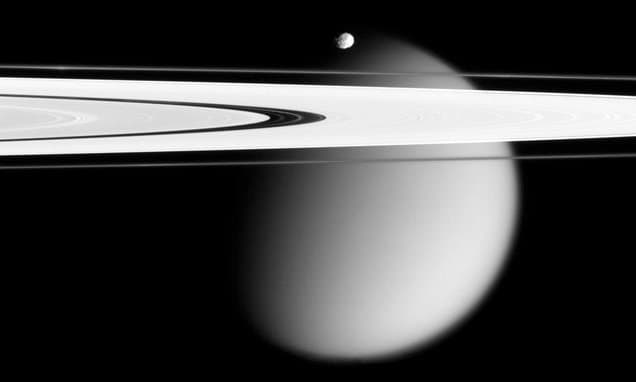
Titan's Ocean Mystery: Ice and Slush Instead?

Scientists have presented new findings suggesting that Saturn's moon Titan might not possess a large underground ocean as previously assumed. Instead, researchers propose that Titan's interior could be composed of deep ice and slush layers, interspersed with pockets of liquid water. This environment, though different from a global ocean, still offers conditions where extraterrestrial life could potentially survive and thrive.

The revised theory stems from a new analysis of data collected years ago by NASA's Cassini spacecraft. By carefully processing observations, scientists detected a 15-hour delay between Saturn's gravitational tug and the resulting deformation of Titan's surface. This gap indicates a slushy interior rather than a liquid ocean, which would produce an immediate response.

These findings suggest that Titan's hydrosphere might be evolving towards complete freezing or that any ocean present has long since frozen. Computer models indicate these ice and water layers could extend hundreds of miles deep. NASA's upcoming Dragonfly mission, a rotorcraft scheduled to launch later this decade, is expected to provide further insights into Titan's internal composition.

Disclaimer: This story has been auto-aggregated and auto-summarised by a computer program. This story has not been edited or created by the Feedzop team.
The Cassini spacecraft's data, re-analyzed by scientists, revealed a 15-hour gap in gravitational pull effects, suggesting Titan has a slushy interior rather than a liquid ocean.
While no life has been found, the new theory of slushy layers with water pockets on Titan offers renewed optimism for the potential presence of microbial extraterrestrial life.
NASA's Dragonfly mission, a rotorcraft designed to explore Titan's surface, is expected to launch later this decade.

Read more news on

Scienceside-arrow

You may also like

Europa's 'Wall Demon' Hints at Hidden Ocean Life

16 Dec • 17 reads

article image

Space Crowded: Starlink Near Miss Sparks Collision Fears

16 Dec • 16 reads

article image

Uranus Radiation Mystery Solved by Voyager 2 Data

5 Dec • 65 reads

article image

Tryptophan Found on Asteroid Bennu: Life's Building Blocks from Space

27 Nov • 121 reads

article image

Blue Origin's Mega Rocket Gets Bigger, Taller Than Saturn V

20 Nov • 143 reads

article image