feedzop-word-mark-logo
searchLogin
Feedzop
homeFor YouIndiaIndia
You
bookmarksYour BookmarkshashtagYour Topics
Trending
Terms of UsePrivacy PolicyAboutJobsPartner With Us

© 2026 Advergame Technologies Pvt. Ltd. ("ATPL"). Gamezop ® & Quizzop ® are registered trademarks of ATPL.

Gamezop is a plug-and-play gaming platform that any app or website can integrate to bring casual gaming for its users. Gamezop also operates Quizzop, a quizzing platform, that digital products can add as a trivia section.

Over 5,000 products from more than 70 countries have integrated Gamezop and Quizzop. These include Amazon, Samsung Internet, Snap, Tata Play, AccuWeather, Paytm, Gulf News, and Branch.

Games and trivia increase user engagement significantly within all kinds of apps and websites, besides opening a new stream of advertising revenue. Gamezop and Quizzop take 30 minutes to integrate and can be used for free: both by the products integrating them and end users

Increase ad revenue and engagement on your app / website with games, quizzes, astrology, and cricket content. Visit: business.gamezop.com

Property Code: 5571

Home / Science / Robots Bloom Like Flowers Adapting to Light

Robots Bloom Like Flowers Adapting to Light

22 Jan

•

Summary

  • Robotic swarms can dynamically adapt facades like flowers.
  • Inspired by nature, robots mimic collective behavior of ants and birds.
  • Princeton's Swarm Garden offers glimpse into adaptive living architecture.
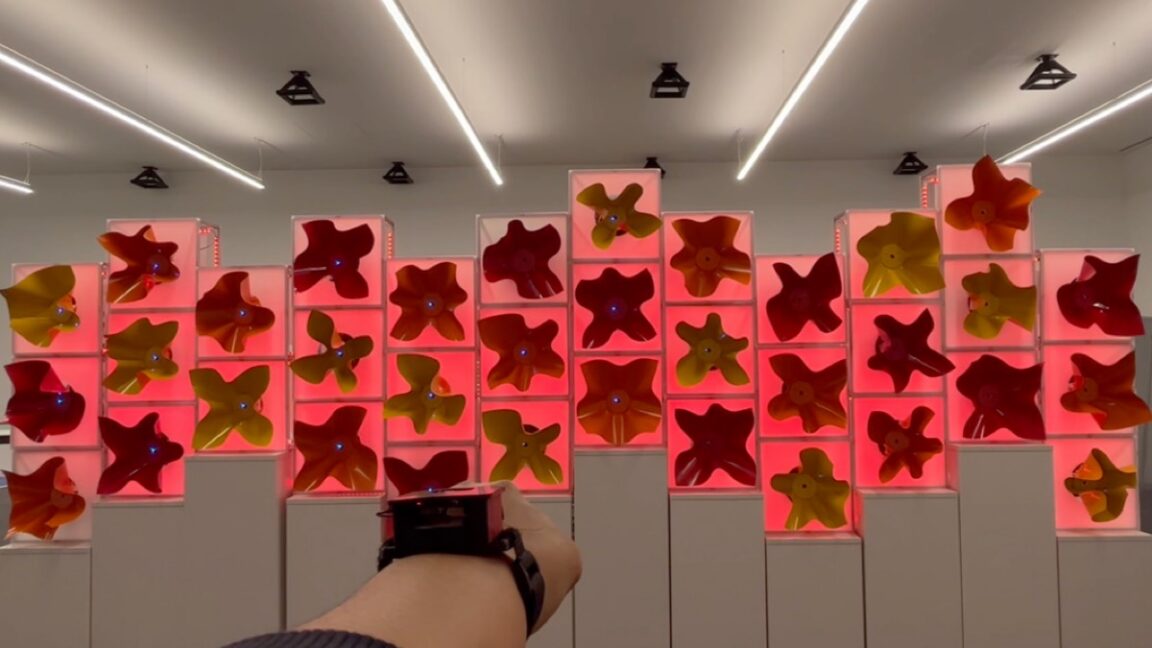
Robots Bloom Like Flowers Adapting to Light

Princeton University researchers have created a "Swarm Garden," a collection of 40 interconnected mini-robots called SGbots. These robots can dynamically change their form, extending or retracting thin sheets to "bloom" or buckle, mimicking natural responses to environmental cues like light.

Inspired by the collective intelligence of ant swarms and flocking birds, the SGbots utilize a Wi-Fi network for communication and collective decision-making. This technology holds potential for architectural applications, such as dynamic building facades that adapt to changing sunlight for shading.

Demonstrated in two case studies, the Swarm Garden provided adaptive shading on an office window and served as an interactive art installation where users controlled bot movements via gestures. Future developments aim for real-world architectural feasibility and more sustainable materials.

trending

SIDBI gets ₹5,000 cr boost

trending

AFCAT 1 admit card released

trending

Hindustan Zinc silver prices surge

trending

India Post expands ATM network

trending

Gold, silver prices fall

trending

RRB amalgamation review meeting

trending

Zerodha warns of MTF risks

trending

Waaree Energies share price jumps

trending

HDFC Bank stock performance

This innovation envisions buildings inspired by "living architectures," featuring facades that continuously adapt to surroundings and occupants. The Swarm Garden offers a preview of this future, creating responsive, animated, and aesthetically pleasing built environments.

Disclaimer: This story has been auto-aggregated and auto-summarised by a computer program. This story has not been edited or created by the Feedzop team.
The Swarm Garden is a proof-of-concept project by Princeton University researchers featuring an array of 40 interconnected mini-robots that respond to environmental stimuli like light.
Each SGbot has light and proximity sensors and an actuator to extend or retract a plastic sheet, enabling collective responses like blooming or buckling.
Potential applications include adaptive shading for buildings and creative interactive interior designs, inspired by natural systems.

Read more news on

Scienceside-arrowArtificial Intelligence (AI)side-arrow

You may also like

Engram Unlocks AI's True Reasoning Power

18 Jan • 21 reads

article image

AI Boom Fuels Skilled Trades Shortage

15 Jan • 32 reads

article image

Robot Lips Sync: Bridging the Uncanny Valley

15 Jan • 25 reads

article image

Deep Robotics: China's CES 2026 Robot Star

7 Jan • 128 reads

article image

AI Friends: Teens Swap Real Bonds for Chatbots

22 Dec, 2025 • 179 reads

article image