
Home / Science / Scientists Recreate Lost Languages of Early Humans
Scientists Recreate Lost Languages of Early Humans
9 Mar
Summary
- Fossilized remains reveal ancient human vocalizations.
- Neanderthals communicated with a comprehensible language.
- Homo erectus may have used rudimentary spoken language.

Scientists are reconstructing the lost languages of ancient human species, revealing how our distant relatives might have communicated. By analyzing fossilized remains, researchers can infer the shape and size of vocal organs like the larynx and tongue, as well as brain regions associated with language.
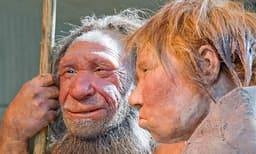
Australopithecus afarensis, emerging around 3.2 million years ago, likely communicated more like chimpanzees than modern humans due to a lack of complex sentence structure. However, by 50,000 years ago, Neanderthals, or Homo neanderthalensis, had developed a language that Homo sapiens could understand.
While Neanderthals possessed physiological differences, such as larger chests for greater lung capacity and pronounced nasal tones, experts believe communication was possible. Professor Steven Mithen suggests that understanding could be achieved through gestures, facial expressions, and the rapid acquisition of each other's words.
Furthermore, evidence suggests Homo erectus, existing between 1.89 million and 110,000 years ago, may have been the first human species to develop a spoken language. Impressions in the skull of a Homo erectus individual, known as the Turkana Boy, indicate a developed Broca's area, linked to language and tool making.
This abstract thought process, necessary for crafting tools like hand axes, is considered a key indicator for language development. The language of Homo erectus would have been simple, using basic words for objects and events, enabling hunting, planning, and eventual migration out of Africa.