Home / Science / Fossil Hunter Finds "Smiling" Ancient Teeth Fossil
Fossil Hunter Finds "Smiling" Ancient Teeth Fossil
19 Feb
Summary
- A 64-year-old woman discovered a rare fossil resembling teeth.
- The fossil is a 350-million-year-old part of a crinoid.
- It was found on Holy Island, a location rich in fossils.
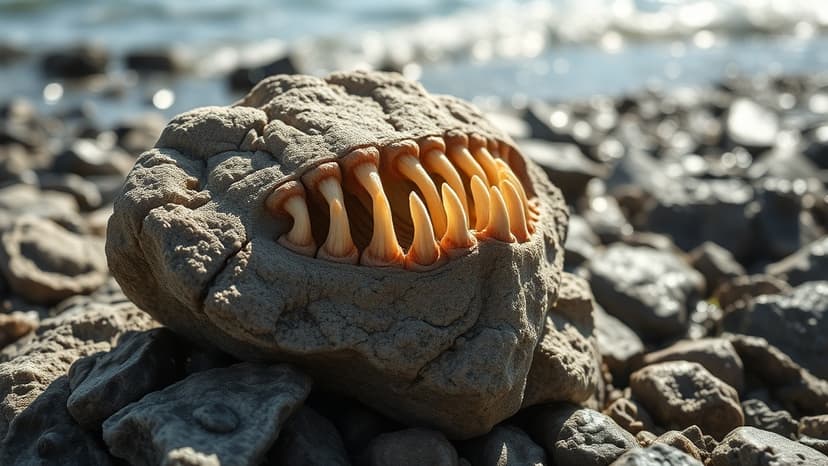
Christine Clark, 64, recently discovered a striking fossil on Holy Island, Northumberland, during a Boxing Day walk. What initially appeared as a "smiling" pebble turned out to be a rare fossilized section of a crinoid, an ancient marine animal. Crinoids first appeared over 500 million years ago and are sometimes called "sea lilies." The fossil Clark found is a "columnal," composed of multiple connected ossicles from the crinoid's stem. This particular specimen is estimated to be approximately 350 million years old, likely from the Alston formation.
Holy Island, known for its historical significance and tidal isolation, is a common location for finding fossils, particularly the stem segments of crinoids known locally as "Cuddy's beads." These beads have been collected for centuries, linked to the folklore of St Cuthbert. While finding individual crinoid ossicles is common, finding a larger, uniquely shaped section like Clark's is rare. The British Geological Survey confirmed the fossil's identity, noting its unusual mouth-like curvature. Despite offers to purchase it, Clark plans to keep her fascinating discovery.


