Home / Science / NASA's PUNCH Mission Revolutionizes Solar Storm Forecasts
NASA's PUNCH Mission Revolutionizes Solar Storm Forecasts
5 Aug
Summary
- PUNCH satellites now provide continuous solar CME imagery.
- New model predicts solar storms with half-hour accuracy.
- Improved forecasts help mitigate power outages and satellite issues.
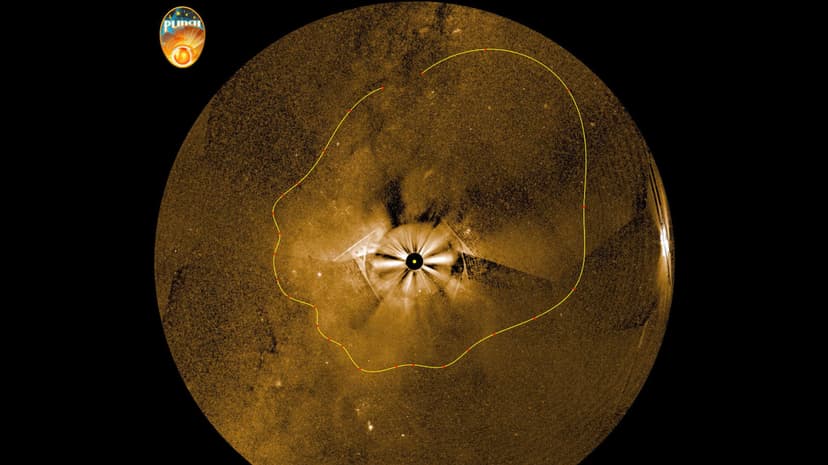
Launched in March 2025, NASA's Polarimeter to Unify the Corona and Heliosphere (PUNCH) mission is enhancing our ability to predict solar weather. This initiative employs a constellation of four microsatellites that continuously monitor the sun, capturing images of coronal mass ejections (CMEs) shortly after their departure.
Recently, the PUNCH team leveraged continuous imagery from a CME on May 31, 2025, to test and refine forecast modeling. By feeding this data into a computer model, scientists were able to track the CME's speed and shape. This analysis led to a prediction that a subsequent solar storm would reach Earth just eight hours later, with an impressive accuracy of within half an hour.
This level of precision represents a substantial advancement over current forecasting methods, which typically have an error margin of five hours. Previously, instruments could only monitor a fraction of a CME's journey, but PUNCH offers comprehensive tracking and captures images as frequently as every four minutes. The PUNCH principal investigator, Craig DeForest, described the results as a "stunning" improvement, akin to advancing from steam engines to modern combustion engines.
Accurate solar storm predictions are vital, as these events can trigger geomagnetic storms. Such storms pose risks of radio blackouts, power outages, and disruptions to satellite operations and internet connectivity. The PUNCH mission's enhanced forecasting capabilities offer a critical tool for mitigating these potential impacts, with ongoing research focused on further refining models for even earlier storm warnings.


