Home / Science / New Solar Tech Solves Perovskite Stability Issues
New Solar Tech Solves Perovskite Stability Issues
2 Mar
Summary
- Crystal-solvate pre-seeding technique controls critical bottom interface.
- Lattice-confined solvent annealing enhances film stability and uniformity.
- New method enables 23.15% efficiency in large-area solar modules.
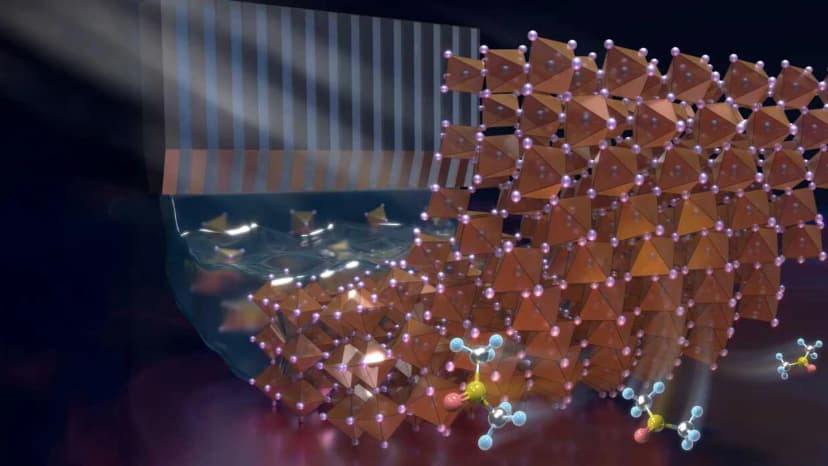
A new crystal-solvate pre-seeding technique has been introduced to enhance the performance and stability of inverted perovskite solar cells (PSCs). This innovative approach by Chinese scientists precisely controls the crucial buried interface between the perovskite and hole transport layers, a common source of defects in conventional designs.
The technique utilizes low-dimensional halide crystal-solvate seeds to guide perovskite crystal growth, ensuring improved precursor spreading and uniform film formation. Embedded DMSO molecules within the crystal structure create a localized solvent annealing environment during heat treatment, promoting grain rearrangement and stability.
This integrated strategy simultaneously addresses crystallization regulation and interface stabilization, leading to reduced interfacial voids and smoother grain boundaries. It has enabled the creation of perovskite solar mini-modules with a 49.91 cm aperture area, achieving a power conversion efficiency of 23.15%. The minimal drop in efficiency from lab-scale cells highlights the technology's success in overcoming scaling challenges for large-area manufacturing.