Home / Science / Conductive Ink Turns Skin Art into Health Trackers
Conductive Ink Turns Skin Art into Health Trackers
14 Jul
Summary
- New ink allows custom skin designs to function as electrodes.
- Sensors monitor heart, brain, and muscle activity directly.
- Stretchy ink offers high skin connectivity and prolonged wear.
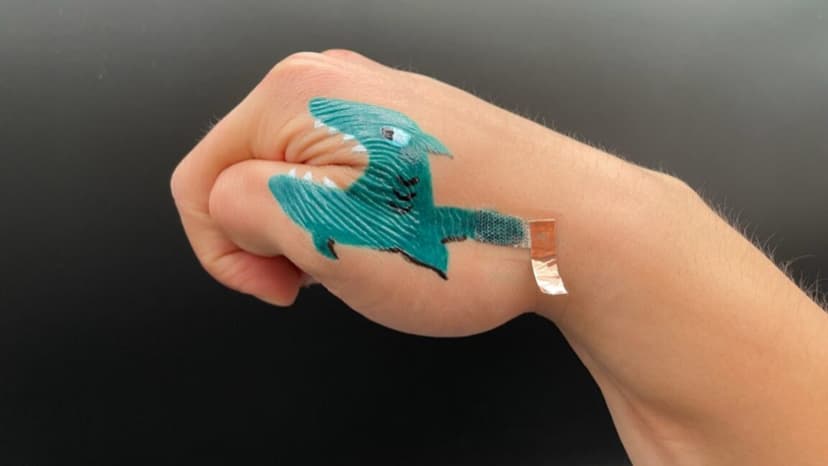
Researchers at Penn State University have developed a groundbreaking conductive ink capable of being painted directly onto skin in colorful, custom designs. Once dried, these painted designs function as electrodes for biomonitoring, offering a novel approach to health tracking. This advancement builds upon existing epidermal electronics, addressing limitations of prior e-tattoos, such as poor performance on curved or hairy surfaces.
The new ink, named WE-PPD, is water-based and formulated with polymers and acidic additives, including PEDOT:PSS for conductivity and DBSA for flexibility. Described as behaving like face paint, it can be pigmented with food dyes to create personalized artistic electrodes. The ink's ability to conform to skin contours ensures high connectivity and accurate signal recording.
Laboratory tests demonstrated the painted sensors' effectiveness in monitoring heart activity during exercise, recognizing gestures for prosthetic control, and tracking brain activity through hair. The electrodes exhibited impressive stretchability, enduring up to 170 percent elongation, and superior water vapor permeability compared to standard medical films. They also proved non-irritating over extended wear periods.
While the team has filed a patent and envisions disposable electrodes with reusable sensing modules, further research is needed. Comprehensive safety evaluations, particularly regarding RF-induced heating, are required before clinical deployment. Future applications may include plant health monitoring due to the sensors' adaptability to complex shapes.


