Home / Science / Cosmic Dawn: Earliest Quasar Discovered
Cosmic Dawn: Earliest Quasar Discovered
24 Nov
Summary
- Oldest quasar dates to 13.1 billion years ago.
- Quasar formed 630 million years post-Big Bang.
- Black hole mass challenges early universe growth theories.
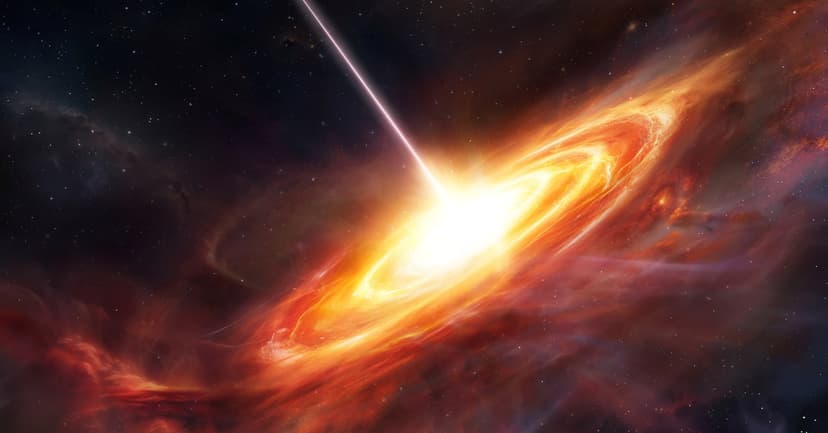
Astronomers have identified the oldest-known quasar, an intensely luminous object powered by a supermassive black hole. This remarkable find dates back over 13.1 billion years, originating when the universe was a mere 630 million years old, representing less than 5% of its current age. This quasar, nicknamed Dún Aonghasa, is a crucial window into the universe's early transformative epoch, when the first stars and galaxies ignited.
The supermassive black hole at the heart of Dún Aonghasa is estimated to be about 360 million times the mass of the sun, a scale that poses significant questions for scientists. "This black hole had already grown to about 360 million times the mass of the sun and was shining as a quasar," stated lead author Julien Wolf. The rapid growth challenges existing models of black hole formation and evolution in the young cosmos, suggesting possibilities like direct collapse rather than stellar remnants.
First detected by the Euclid telescope and further studied with other observatories, Dún Aonghasa provides vital clues about how the earliest galaxies formed and how their central black holes achieved such enormous sizes so quickly. Researchers believe that further observations may unveil even older quasars, pushing the boundaries of our understanding of the universe's infancy.


