Home / Science / Quantum Leap: Scientists Unravel Nuclear Stability Secret
Quantum Leap: Scientists Unravel Nuclear Stability Secret
16 Feb
Summary
- Researchers explained decades-old atomic nuclei magic numbers.
- New theory bridges independent particle and interaction models.
- The work connects nuclear structure to relativity and symmetry.
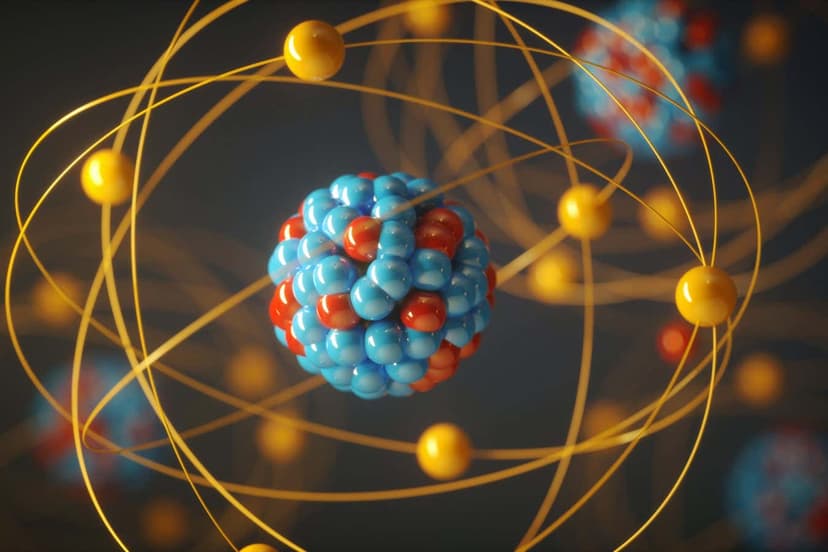
Decades of nuclear physics research have centered on "magic numbers," specific quantities of protons and neutrons that confer exceptional stability to atomic nuclei. While a shell model proposed discrete energy levels for nuclear particles, this conflicted with the understanding that these particles interact strongly.
A recent study, spearheaded by Jiangming Yao and his colleagues, has resolved this contradiction by developing a theory grounded in first principles. This new model mathematically describes particle interactions and the energy required to separate them, effectively bridging the high-resolution quantum reality with the lower-resolution shell model.
The researchers tracked changes in particle symmetry as they blurred their high-resolution calculations. This revealed that nuclear structure achieves maximum stability when particles group according to magic numbers. This theoretical probe, akin to a mathematical microscope, mirrors experimental observations and connects nuclear stability to principles of special relativity, offering a comprehensive view.
Initial tests of the theory have focused on doubly magic tin isotopes and other nuclei. Future work aims to extend this analysis to heavier, often unstable, nuclei and explore their creation processes in cosmic events like exploding stars.