Home / Science / MIT's Smart Material Folds into Any 3D Shape with a Pull
MIT's Smart Material Folds into Any 3D Shape with a Pull
28 Dec, 2025
Summary
- New material inspired by Japanese kirigami art transforms flat grids into 3D structures.
- An algorithm translates 3D designs into foldable grids with an optimal string path.
- The technology has potential applications from medical devices to space habitats.
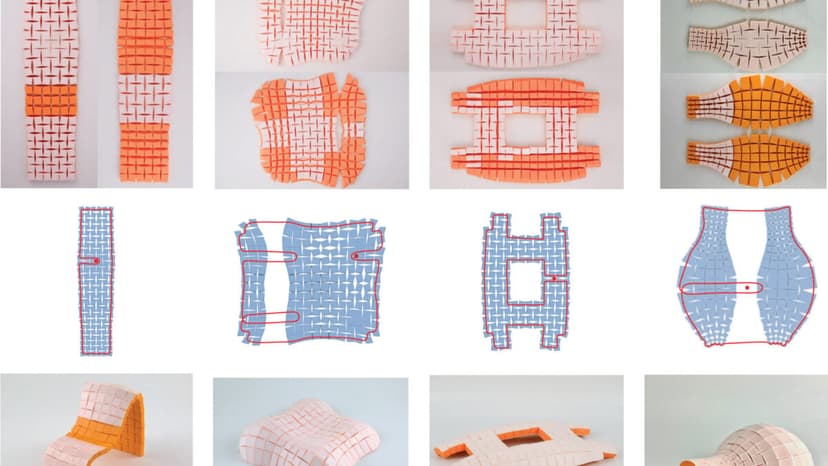
Scientists have created a groundbreaking material that mimics the principles of kirigami, a Japanese paper art form. This innovative material can transition from a flat, tiled pattern into complex three-dimensional shapes simply by pulling a small string. The research team developed a sophisticated algorithm that precisely cuts and encodes material properties, enabling its transformation. This new technology, pioneered by researchers at MIT, offers a unique approach to creating deployable structures.
The core of this innovation lies in an algorithm that converts user-defined 3D models into a flat, foldable grid. This process is akin to how kirigami artists imbue paper with special characteristics through strategic cuts. The algorithm calculates the ideal string path, ensuring a smooth and efficient conversion to the intended 3D form. This mechanism is described as an auxetic one, meaning it expands when stretched and contracts when compressed, adding to its versatility.
Potential applications for this smart material are vast, ranging from transportable medical devices like splints and posture correctors to modular space habitats for Mars. The team has even demonstrated its capability by fabricating a fully deployable, human-sized chair from laser-cut plywood. While challenges remain for larger architectural applications, the researchers are actively exploring ways to scale up this accessible and ingenious fabrication method.