Home / Science / NASA Pushes Mars Rotor Speeds to Supersonic Levels
NASA Pushes Mars Rotor Speeds to Supersonic Levels
18 Nov
Summary
- Mars helicopter blades were tested above the speed of sound.
- Supersonic speeds increased lift capability by 30% on Mars.
- New Mars helicopters could launch as early as December 2028.
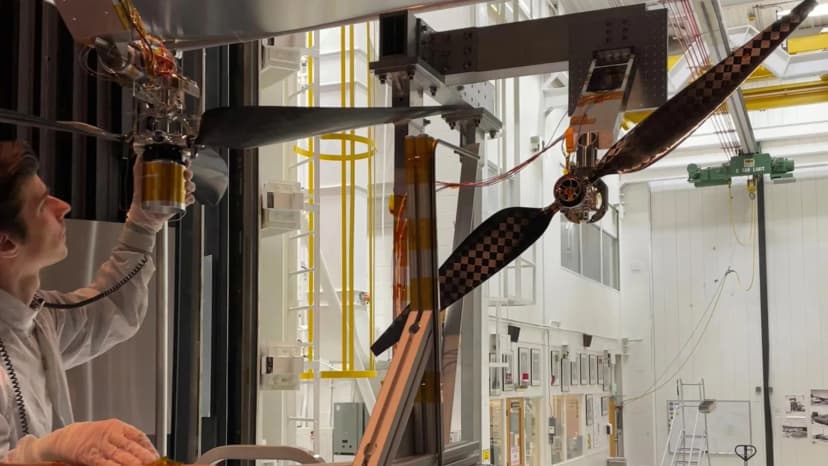
NASA is pushing the boundaries of helicopter flight on Mars by testing rotor blades at speeds previously considered too risky. Engineers at the Jet Propulsion Laboratory (JPL) successfully propelled experimental Mars helicopter blade tips beyond the speed of sound without them breaking apart. These tests were performed within a specialized chamber simulating Mars' thin atmosphere. The results from 137 test runs aim to enable future aircraft to carry heavier scientific instruments and travel greater distances across the Red Planet.
Flying on Mars presents unique challenges due to its atmosphere, which is only about 1% as dense as Earth's. To generate sufficient lift, rotors must spin at exceptionally high speeds. In previous flights, the Ingenuity helicopter's rotors were limited to 2,700 revolutions per minute (rpm) to stay below Mach 1. New rotor designs, including a three-bladed system and a two-bladed system for the SkyFall project, were tested.
The experimental rotors reached speeds of Mach 1.08, surpassing the sound barrier and boosting lift capability by 30%. This enhanced lift is vital for future missions, allowing helicopters to transport more advanced scientific equipment and sensors. NASA's SkyFall project plans to deliver three next-generation helicopters to Mars in December 2028, significantly expanding exploration possibilities.


