

Home / Science / Arctic Ice Core Reveals Human Pollution's Frozen Footprint
Arctic Ice Core Reveals Human Pollution's Frozen Footprint
20 Apr
Summary
- 91-meter ice core from IGAN Glacier shows human activity's impact.
- Ash and slag particles link ice history to Vorkuta coal deposit.
- Isotopic data aids understanding of Arctic ice sheet formation.
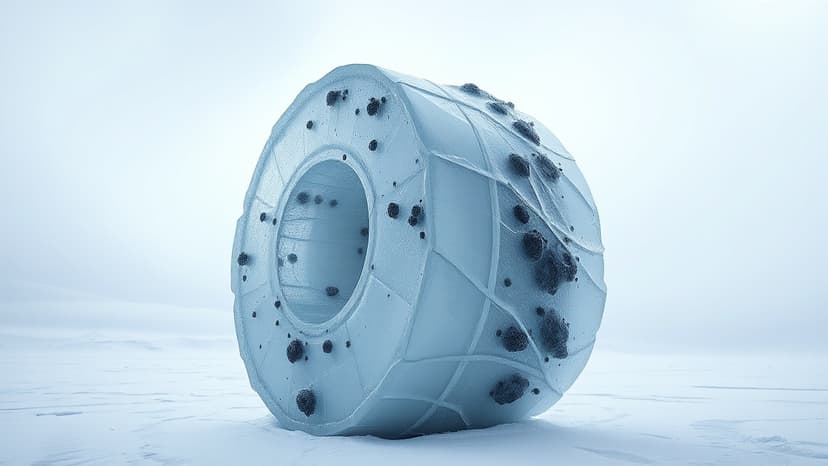
For the first time, scientists have successfully drilled the IGAN Glacier, located in the Polar Urals. A detailed analysis of a 91-meter glacial core has unveiled the presence of particles strongly suggesting human industrial activity. These discovered ash and slag particles serve as a historical marker, allowing researchers to correlate the history of ice accumulation with the extensive development of the Vorkuta coal deposit.
The research team, led by Doctor of Geographical Sciences Vladimir Mikhalenko, meticulously studied the ice samples. They examined particle content, morphology, composition, and the isotopic ratios of oxygen and hydrogen. Electron microscopy revealed tiny aluminum-silicate spheres and high-carbon substances consistent with waste from a local Central Heating Power Plant, directly linking them to coal mining operations.
Further analysis of oxygen and hydrogen isotopes within the ice core, alongside density measurements, provided insights into the glacier's formation and the influence of local precipitation patterns. The scientists concluded that the annual accumulation layer is primarily formed by meltwater and rain. This groundbreaking study enhances our understanding of Arctic glacier formation, illustrates industrial impact on local ecosystems, and establishes a foundation for future climate predictions and cryosphere monitoring.
