Home / Science / Giant Exoplanets Defy Formation Theories
Giant Exoplanets Defy Formation Theories
2 Mar
Summary
- Massive gas giants, 5 to 10 times Jupiter's mass, orbit far from their star.
- JWST detected sulfur, indicating solid material incorporation during formation.
- Planet formation models struggle to explain these super-sized, distant worlds.
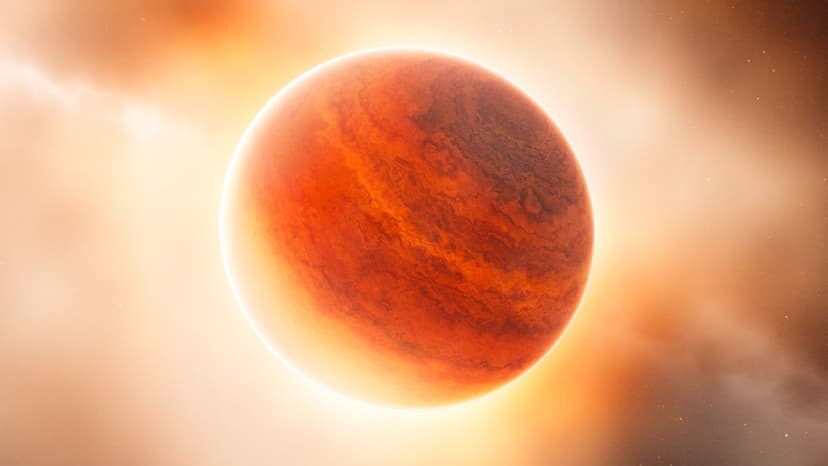
Astronomers are investigating colossal gas giants found in distant star systems, some of which are between 5 to 10 times the mass of Jupiter. These massive planets orbit their stars at distances up to 70 astronomical units, posing a puzzle for conventional theories of planet formation, such as core accretion. Traditional models struggle to explain how such large planets could accumulate sufficient material so far from their star before the protoplanetary disk dissipates.
Utilizing data from the James Webb Space Telescope (JWST), researchers analyzed the atmospheric composition of three gas giants orbiting the star HR 8799, located approximately 130 light-years away. The detection of hydrogen sulfide in the atmospheres of these planets provided strong evidence that significant amounts of solid material were incorporated during their formation. This finding implies that these super-sized exoplanets likely formed through processes similar to those that created Jupiter, despite their much greater mass.
The enrichment of heavy elements, including sulfur, carbon, and oxygen, in the planets' atmospheres compared to their host star is particularly noteworthy. The efficiency with which these planets formed is surprising and difficult to reconcile with current classical formation models. Further studies of other exoplanetary systems will be necessary to understand the prevalence and formation mechanisms of such massive, distant worlds.