Home / Science / Eclipse Chaser Hunts Aurora During Solar Totality
Eclipse Chaser Hunts Aurora During Solar Totality
10 Aug
Summary
- Veteran eclipse chaser Michael Zeiler is on an expedition to Greenland.
- Zeiler hopes to observe an aurora during total solar eclipse totality.
- Eclipse path predictions are highly accurate, refined over centuries.
Michael Zeiler is embarking on an expedition to the fjords of Greenland aboard the Ocean Explorer, aiming to witness the upcoming total solar eclipse. He harbors a unique ambition: to achieve the first-ever observation of an aurora occurring simultaneously with solar eclipse totality. Zeiler also hopes to spot meteors from the Perseid shower, though these celestial displays depend heavily on luck.
Thanks to powerful computer models and precise measurements, the paths of total solar eclipses are predictable years in advance. Eclipse cartographer Zeiler, founder of EclipseAtlas.com, has been creating eclipse maps for over two decades, guiding others to witness these events. His maps integrate thousands of years of astronomical data and calculations.
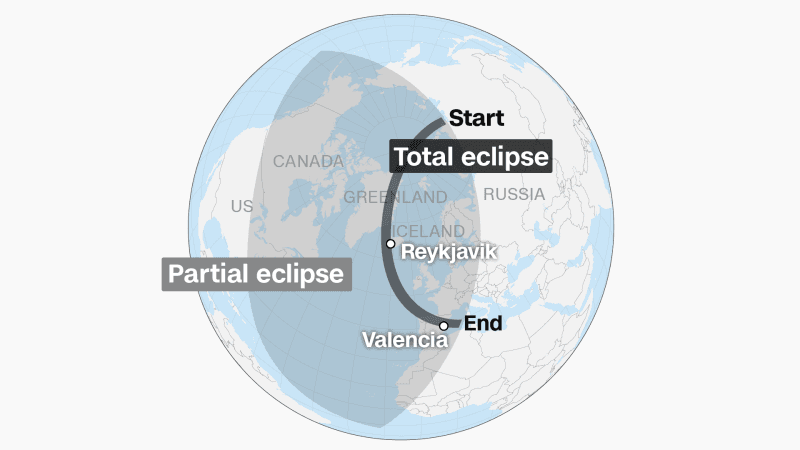
Totality is experienced by observers within the narrow path of the moon's umbra. This year's eclipse path will cross parts of Greenland, Iceland, northern Spain, and northeastern Portugal. Partial eclipses will be visible across Europe, Africa, and North America. The path of totality spans 5,157 miles, with durations varying by location, such as approximately one minute in Reykjavík, Iceland, and two minutes in León, Spain.
Scientific predictions for eclipse paths are highly accurate, with current precision around one to one-and-a-half kilometers. Solar physicist Alex Young notes that ongoing solar missions contribute data for continuous improvement. The next total solar eclipses are predicted for August 2, 2027, visible in North Africa and the Middle East, and August 23, 2044, visible in parts of the contiguous United States.
The ancient Babylonians first recorded the saros cycle, a roughly 18-year pattern of eclipses. This cycle, along with factors like the moon's orbital position and distance from Earth, allows for advanced predictions. However, Earth's rotation fluctuates, necessitating a correction called Delta T. This limits prediction accuracy to approximately 3,000 years into the future and 2,000 years into the past.


