Home / Science / Early Universe Chaos Fueled Supermassive Black Hole Growth
Early Universe Chaos Fueled Supermassive Black Hole Growth
26 Jan
Summary
- Early chaotic conditions triggered small black holes to devour material.
- Advanced simulations revealed rapid growth in first black holes.
- Dense, gas-rich early galaxies drove extreme black hole growth.
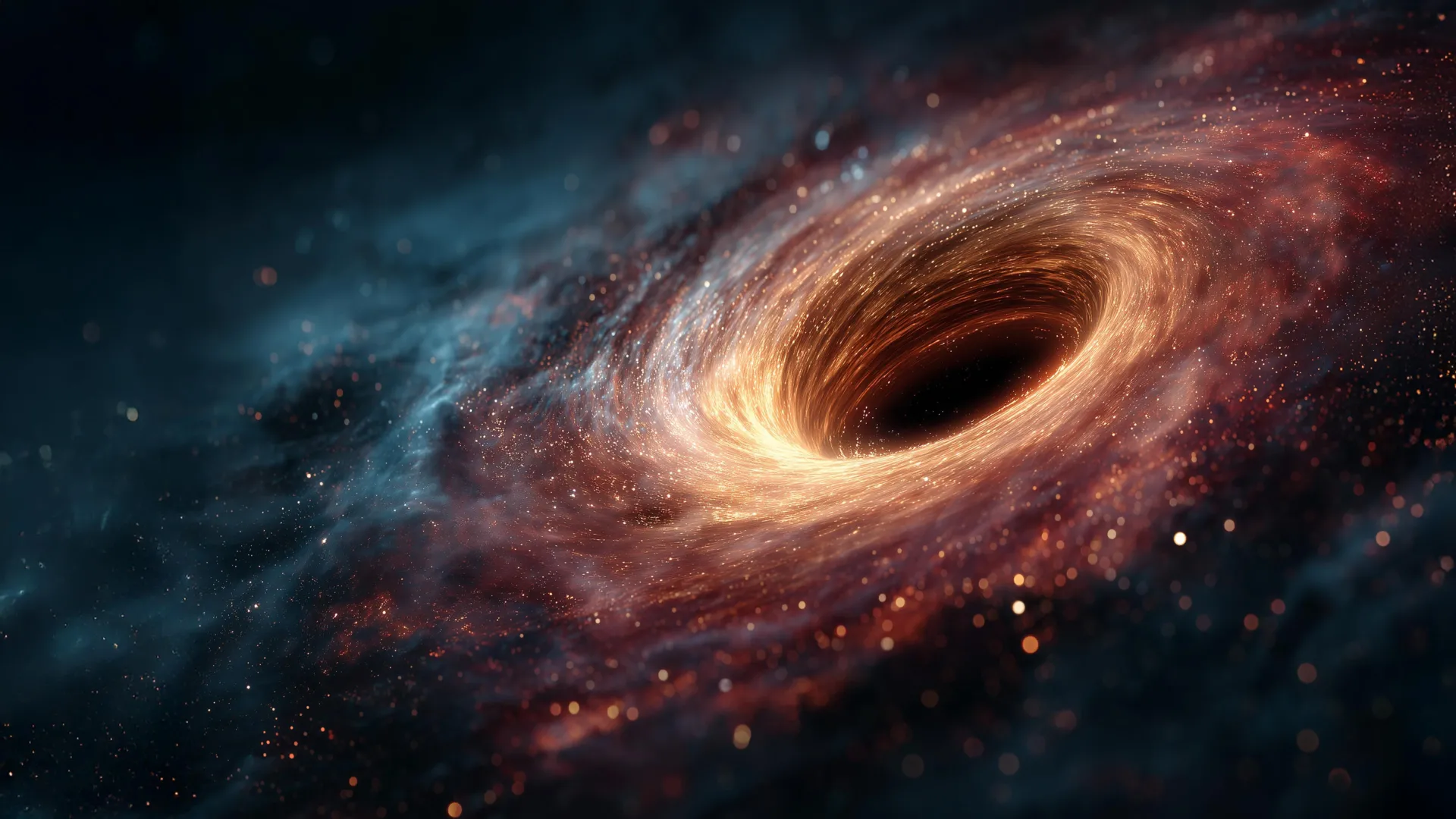
A groundbreaking study from Maynooth University offers a compelling explanation for how supermassive black holes achieved immense sizes in the early universe. Researchers utilized advanced computer simulations to reconstruct the behavior of the first black holes, which formed just a few hundred million years after the Big Bang.
These simulations revealed that the chaotic and dense conditions of the early cosmos, particularly within gas-rich galaxies, triggered a 'feeding frenzy' for early black holes. This process, known as super Eddington accretion, allowed them to grow at rates far exceeding conventional astrophysical models, resolving a long-standing astronomical puzzle.
The findings challenge previous assumptions that only massive 'heavy seed' black holes could explain early supermassive black holes. The research suggests that even smaller 'light seed' black holes could grow spectacularly fast under the turbulent conditions present shortly after the Big Bang. This discovery has implications for future gravitational wave observations from missions like LISA, potentially detecting mergers of these early, rapidly growing black holes.