Home / Science / Cosmic Enigma: 'Cloud-9' Could Reveal Dark Matter's Nature
Cosmic Enigma: 'Cloud-9' Could Reveal Dark Matter's Nature
9 Jan
Summary
- A newly discovered object, nicknamed Cloud-9, might be a remnant of early galaxy formation.
- This starless cloud offers a rare glimpse into dark matter's elusive properties.
- Future studies of Cloud-9 could unlock secrets of dark matter and cosmic evolution.
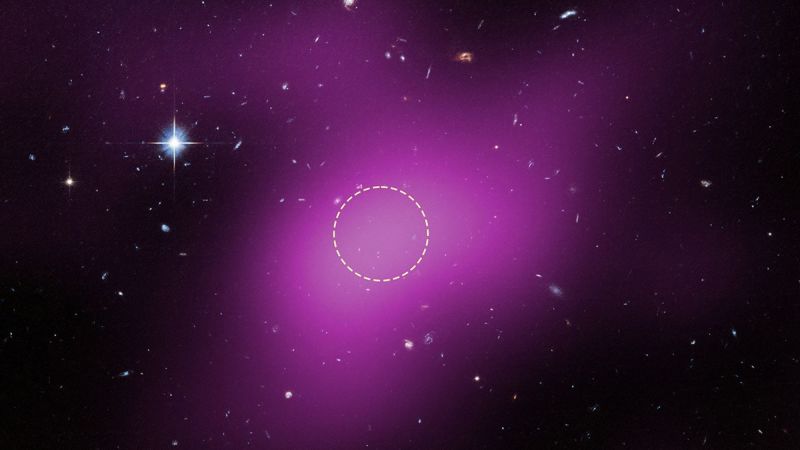
Astronomers have identified a potential new type of celestial object, nicknamed Cloud-9, which could be instrumental in understanding dark matter. This enigmatic substance, thought to comprise 85% of the universe's mass, shapes the cosmos but has never been directly observed. Cloud-9's significance lies in its potential to be a primordial remnant from the universe's early formation stages.
Observations, including those from the Hubble Space Telescope, revealed Cloud-9 to be entirely starless, defying typical galaxy formation models. This 'failed galaxy' is rich in dark matter, estimated at 5 billion solar masses, with only about 1 million solar masses of neutral hydrogen. Scientists believe it exists in a delicate balance, possessing enough mass to retain its gas but not enough to initiate star formation.
Discovered three years ago near the Messier 94 galaxy, Cloud-9's unique characteristics are prompting further investigation. While some suggest it might be an exceptionally faint galaxy, its starless nature points towards a significant dark matter component. Future observations aim to resolve its core and potentially confirm its dark matter dominance, offering a crucial window into the universe's fundamental mysteries.