feedzop-word-mark-logo
searchLogin
Feedzop
homeFor YouIndiaIndia
You
bookmarksYour BookmarkshashtagYour Topics
Trending
trending

Counterfeit rabies vaccine alert issued

trending

India U19 World Cup squad

trending

Gambhir's fate depends on T20

trending

Jurrien Timber injury unites Arsenal

trending

Nigeria vs Tunisia AFCON match

trending

Juventus faces Pisa Saturday

trending

Kartik Aaryan film earns crores

trending

Spalletti explains Juventus changes

trending

De'Aaron Fox out versus Jazz

Terms of UsePrivacy PolicyAboutJobsPartner With Us

© 2025 Advergame Technologies Pvt. Ltd. ("ATPL"). Gamezop ® & Quizzop ® are registered trademarks of ATPL.

Gamezop is a plug-and-play gaming platform that any app or website can integrate to bring casual gaming for its users. Gamezop also operates Quizzop, a quizzing platform, that digital products can add as a trivia section.

Over 5,000 products from more than 70 countries have integrated Gamezop and Quizzop. These include Amazon, Samsung Internet, Snap, Tata Play, AccuWeather, Paytm, Gulf News, and Branch.

Games and trivia increase user engagement significantly within all kinds of apps and websites, besides opening a new stream of advertising revenue. Gamezop and Quizzop take 30 minutes to integrate and can be used for free: both by the products integrating them and end users

Increase ad revenue and engagement on your app / website with games, quizzes, astrology, and cricket content. Visit: business.gamezop.com

Property Code: 5571

Home / Science / Armchair Astronomers Wanted for Black Hole Hunt

Armchair Astronomers Wanted for Black Hole Hunt

30 Dec

•

Summary

  • Volunteers sought for an online challenge to find stars torn apart by black holes.
  • A decade-long survey will generate vast amounts of astronomical data requiring AI.
  • Participants will use machine learning to analyze simulated data for 'tidal disruption events'.
Armchair Astronomers Wanted for Black Hole Hunt

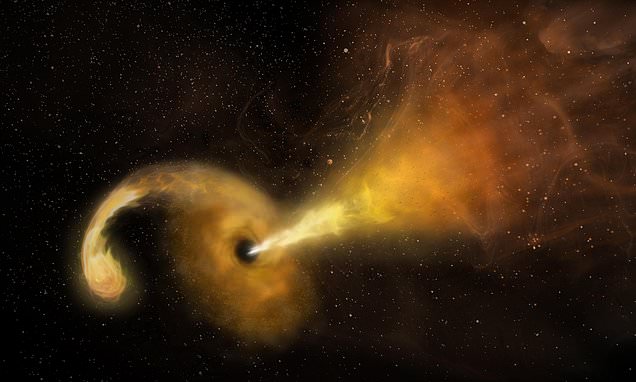
An online challenge is inviting volunteers to help astronomers identify stars being consumed by black holes. Researchers are seeking assistance to refine methods for detecting massive black holes over the next decade. The upcoming Legacy Survey of Space and Time, conducted over ten years from Chile's Vera C Rubin Observatory, is expected to yield more astronomical data than ever before.

This immense dataset, estimated at 10 million alerts nightly, necessitates the use of artificial intelligence and machine learning for analysis. Scientists are calling for 'armchair astronomers' with machine learning experience to sift through simulated data. The goal is to train AI to pinpoint 'tidal disruption events,' where stars are torn apart by extreme gravitational forces near supermassive black holes.

These tidal disruption events are crucial for understanding black hole properties that are otherwise difficult to observe. By analyzing simulations and enlisting global help, scientists hope to discover thousands of these events and further unravel the universe's mysteries. The competition offers a top prize of 1,000 euro.

Disclaimer: This story has been auto-aggregated and auto-summarised by a computer program. This story has not been edited or created by the Feedzop team.
The LSST is a 10-year project from the Vera C Rubin Observatory in Chile that will capture vast amounts of data about the night sky.
Volunteers can use AI and machine learning on simulated data to help identify stars being destroyed by black holes.
These events occur when a star gets too close to a supermassive black hole and is ripped apart by its gravitational forces.

Read more news on

Scienceside-arrowArtificial Intelligence (AI)side-arrow

You may also like

Alien Life: UK Scientist Predicts Discovery Within 50 Years

21 Dec • 32 reads

article image

Exotic Exoplanet Orbits Dead Star, Stretches to Lemon Shape

19 Dec • 60 reads

article image

AI to Unlock 3D Black Hole Movies

19 Dec • 62 reads

article image

Hubble's Latest Glimpse: Comet 3I/ATLAS Approaches Earth

8 Dec • 131 reads

article image

LIGO's Laser Precision Unlocks Deeper Universe

4 Dec • 113 reads

article image