Home / Science / 2,000-Year-Old Prints Emerge from Storms
2,000-Year-Old Prints Emerge from Storms
8 Mar
Summary
- Ancient footprints were discovered on a Scottish beach after winter storms.
- Archaeologists dated the prints to the early first century A.D., approximately 2,000 years ago.
- The rare find, the first of its kind in Scotland, was documented before the sea reclaimed it.

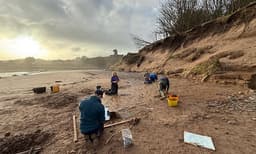
Ancient footprints, approximately 2,000 years old, were recently uncovered on Lunan Bay beach in Angus, Scotland, after winter storms shifted the sands. The discovery was made by locals Ivor Campbell and Jenny Snedden, who alerted archaeologists. A team from the University of Aberdeen, led by Professor Kate Britton, undertook an urgent excavation despite challenging conditions, including high winds.
The footprints have been dated to the early first century A.D., a period coinciding with the Roman Empire. While similar prints have been found in England, this is the first such discovery in Scotland. Archaeologists successfully created 3D models and physical casts of the prints before they were lost to the sea within days.
Professor Britton highlighted the rarity of such finds, describing the site as a "once-in-a-career" opportunity. The analysis of plant sub-fossils and sediment layers suggests the area was once a muddy estuary or salt-marsh, attractive to both animals and people. The public's role in reporting coastal erosion sites was emphasized as crucial for preserving such discoveries.