Home / Science / 1000-Year-Old Astrolabe Celebrates Milestone
1000-Year-Old Astrolabe Celebrates Milestone
22 Feb
Summary
- An ancient astrolabe made in 11th-century Spain is now 1,000 years old.
- The rare instrument was used for charting the position of stars.
- It is one of Europe's oldest surviving signed and dated astrolabes.
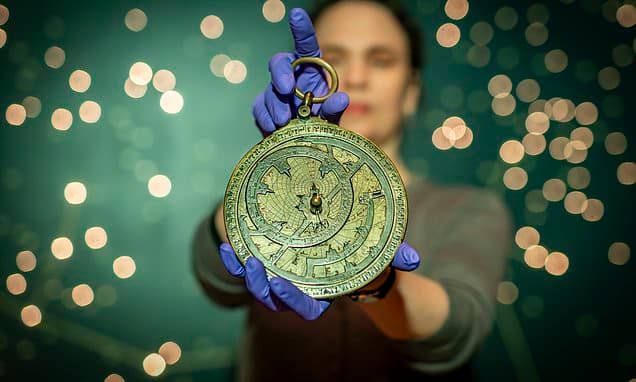
An extraordinary scientific instrument, dating back to the 11th century, has achieved a remarkable milestone: its 1,000th birthday. The astrolabe, an intricate brass device, was expertly crafted in Spain during that era.
Created in Cordoba by Muhammad ibn al-Saffar and precisely dated to 417 AH (1026-1027 AD), this two-dimensional model represents the celestial motions. Historically, it served to observe, calculate, and predict the positions of the sun and stars.
Its applications were diverse, including timekeeping, navigation, and astrology. National Museums Scotland proudly holds this artifact, recognizing it as one of Europe's most ancient surviving signed and dated astrolabes.
The astrolabe was gifted to the museum in 1959 and is now a permanent exhibit. It serves as a profound link connecting science, history, and culture, illuminating how early scholars studied the stars and shaped the modern world.