Home / Environment / US Data Centers' Hidden Carbon Footprint Revealed
US Data Centers' Hidden Carbon Footprint Revealed
16 Nov
Summary
- US data centers emit 25.7 million metric tons of CO2 annually.
- These facilities use nearly 2% of US electricity, more than two cities.
- Lack of transparency hinders understanding of AI's environmental impact.
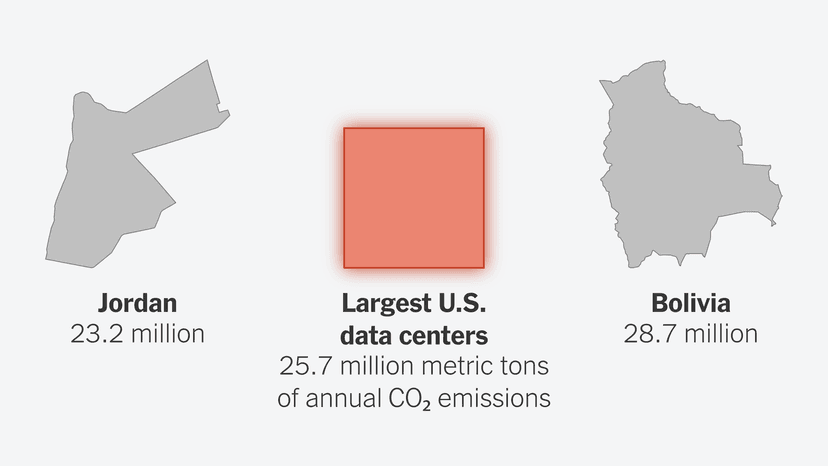
The largest U.S. data centers now account for approximately 25.7 million metric tons of carbon dioxide emissions each year, a figure comparable to the annual emissions of Bolivia. A recent Harvard-led study, published in Nature Sustainability, analyzed 403 major data centers between May 2024 and April 2025.
These facilities collectively used nearly 2% of U.S. electricity, surpassing the combined consumption of New York City and Los Angeles, and contributed about 0.5% to national carbon dioxide emissions. Data centers in Virginia, Iowa, and Ohio were responsible for roughly half of these emissions.
Researchers faced significant challenges due to industry secrecy, with many companies operating without public disclosure of their energy use or environmental impact. This lack of transparency requires extensive investigative work, involving analysis of satellite imagery and public records to estimate electricity consumption and emissions.
Despite efforts to move towards stricter oversight in some states, the federal government has been urged to mandate public reporting of electricity use and emissions from large data centers. Communities are increasingly opposing data center projects due to concerns over their environmental footprint, with local ballot initiatives frequently limiting or preventing new developments.
At least 70 AI data center projects across 25 states, valued at an estimated $271 billion, have been blocked or delayed by local opposition between March 2024 and early November 2026. Virginia, a hub for data centers, saw 14 projects impacted, with its data centers contributing over a quarter of the study's estimated emissions.
This study provides a crucial baseline, though it excludes facilities that bypass the grid and hundreds of unverified centers. The industry is rapidly expanding; upcoming projects are expected to be vastly larger than current facilities, indicating a potential for significantly increased future emissions and environmental impact.


