

Home / Environment / Ancient Cattle Breed Faces Urgent Risk
Ancient Cattle Breed Faces Urgent Risk
21 Apr
Summary
- White park cattle moved to 'priority' category due to declining numbers.
- Calf numbers fell to less than two-thirds of 2022 levels last year.
- Conservationists urge better government support for rare livestock.
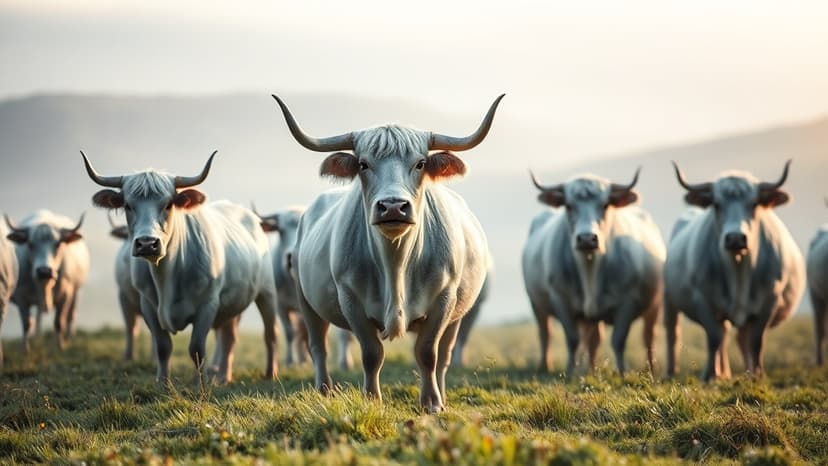
Ancient white park cattle, a breed with roots tracing back two thousand years to the Celts, have been officially designated as urgently at risk by the Rare Breeds Survival Trust (RBST). This classification was made on Tuesday, when the RBST published its 2026 watchlist.
New calf numbers for white park cattle last year fell significantly, reaching less than two-thirds of the levels recorded in 2022. Consequently, the RBST has moved the breed to its 'priority' category, indicating a critical conservation status.
Alongside white park cattle, three other native breeds—original population lincoln red cattle, boreray sheep, and soay sheep—have also been elevated from 'at-risk' to the 'priority' category. This collective reclassification underscores a growing concern for the preservation of Britain's unique livestock heritage.
The RBST is actively advocating for enhanced governmental support for rare native livestock and equines. CEO Christopher Price emphasized that this support should extend beyond financial aid to encompass environmental policies that acknowledge the ecological value of these animals.
White park cattle are distinguished from modern commercial breeds, described by Price as 'semi-wild animals that were partially domesticated'. Their long-horned ancestors are believed to have accompanied the Celts, later gaining prominence through the medieval period before declining with industrialised farming.
Conservation grazing is another area where white park cattle excel. Their hardiness makes them ideal for managing habitats and enhancing biodiversity in meadows and pasture lands. The RBST argues for better inclusion of such 'kept' animals in biodiversity strategies.
Despite the challenges, some farmers continue to champion white park cattle for their exceptional beef quality, noted for its fine marbling and rich flavor. The breed's genetic diversity is also a crucial factor in maintaining agricultural resilience.
A spokesperson for Defra acknowledged the genetic and heritage value of native and rare breeds. The department has committed to supporting these breeds through sustainable farming schemes, including funding for grazing habitats, aiming to safeguard this vital aspect of rural heritage.
