

Home / Environment / Manipur's Dancing Deer: A Floating World Fights Extinction
Manipur's Dancing Deer: A Floating World Fights Extinction
4 Apr
Summary
- World's only floating national park is home to Manipur's dancing deer.
- Sangai deer population recovered from 14 in 1975 to 260 by 2016.
- Climate change threatens to shrink habitat, confining deer to a small core area.
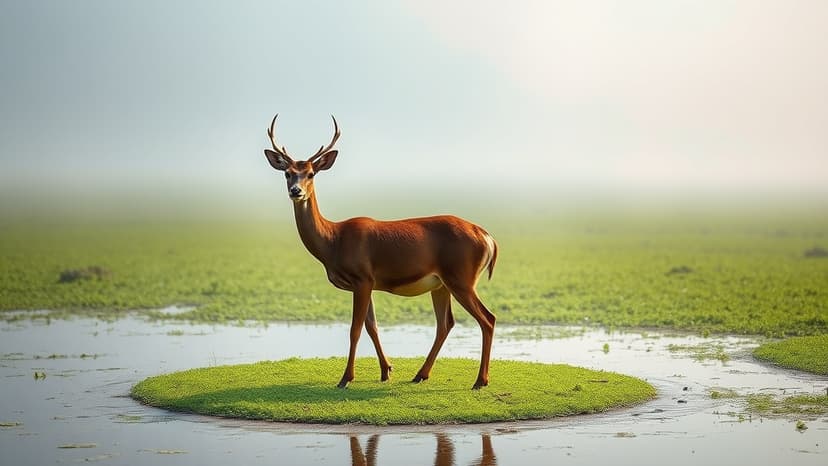
Keibul Lamjao National Park in Manipur is a unique ecological marvel, recognized as the world's only floating national park. It is the sole habitat of the Sangai, Manipur's endemic "dancing deer," whose existence is intrinsically linked to the park's floating vegetation mats, known as phumdis.
Initially declared extinct by 1954 due to hunting and habitat loss, a small population of Sangai was rediscovered in 1975, numbering just 14 individuals. This rediscovery spurred crucial conservation efforts, leading to a significant population increase to 260 by 2016. The park was declared a national park in 1977 to enhance protection strategies.
The phumdis, complex buoyant structures formed over millennia, provide the Sangai with essential habitat, grazing, and breeding grounds. However, conservationists note that the natural cycle of phumdis has been disrupted by altered water levels, posing an ecological challenge.
Conservation initiatives include active habitat management, such as stabilizing and expanding phumdis, vegetation monitoring, and fire management. Efforts also focus on community involvement, promoting alternative livelihoods like ecotourism to reduce dependency on park resources.
Despite successful conservation, the Sangai remains vulnerable as a single isolated population. Concerns exist regarding diseases, natural disasters, and genetic issues like inbreeding. Plans are underway to establish alternative habitats and a conservation breeding center to mitigate these risks.
A recent study projects that climate change could cause the Sangai's suitable habitat to shrink dramatically, confining it to the park's central core by 2070. This forecast highlights the urgent need for continued adaptive management and habitat preservation.
