Home / Environment / Japan's Nights Burn Hotter Than Expected
Japan's Nights Burn Hotter Than Expected
3 Sep
Summary
- Tropical nights in Tokyo more than doubled from 43 in 1990 to 70 in 2025.
- Heatstroke alerts in Tokyo have surged from an expected seven to 40 days annually.
- Experts advise leaving air conditioning on at a low setting for overnight cooling.
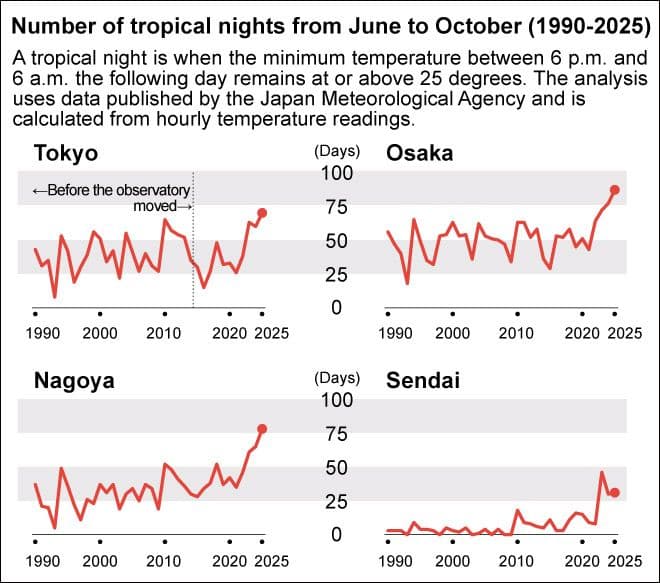
Summer nights in Japan are becoming significantly hotter, with a marked rise in tropical nights and heatstroke alerts. A tropical night is defined as temperatures staying above 25 degrees Celsius between 6 p.m. and 6 a.m. Tokyo recorded 70 tropical nights in 2025, a substantial increase from 43 in 1990. Other cities like Osaka and Nagoya also experienced more than double the number of tropical nights compared to 1990.
The Japan Meteorological Agency attributes this trend to climate change and urban heat-island effects, where built environments absorb and re-emit heat. This phenomenon slows down natural overnight cooling processes.
Heatstroke warnings, issued when the Wet Bulb Globe Temperature is forecast to reach 33 or higher, have also climbed dramatically since their introduction in 2021. Tokyo, which initially expected around seven alert days per year, logged 40 alert days in 2025, with 36 already recorded as of September 2, 2026. This alarming trend is not limited to the capital, with prefectures like Wakayama and Nagasaki reporting over 60 alert days in 2025.
To cope with these increasingly hot nights, experts suggest running air conditioners at a low setting overnight. Experiments indicate that homes can warm significantly within an hour of AC shut-off, with humidity also rising. Recommended thermostat settings vary, generally 27-28 degrees Celsius for women and 25-26 degrees for men.


