Home / Environment / Rivers in Crisis: Major Waterways Degrade Significantly
Rivers in Crisis: Major Waterways Degrade Significantly
11 Mar
Summary
- Five major rivers show degradation, failing water quality standards.
- Pollution sources include industrial discharge, sand mining, and waste dumping.
- CPCB monitors water quality nationwide under its National Water Quality Programme.
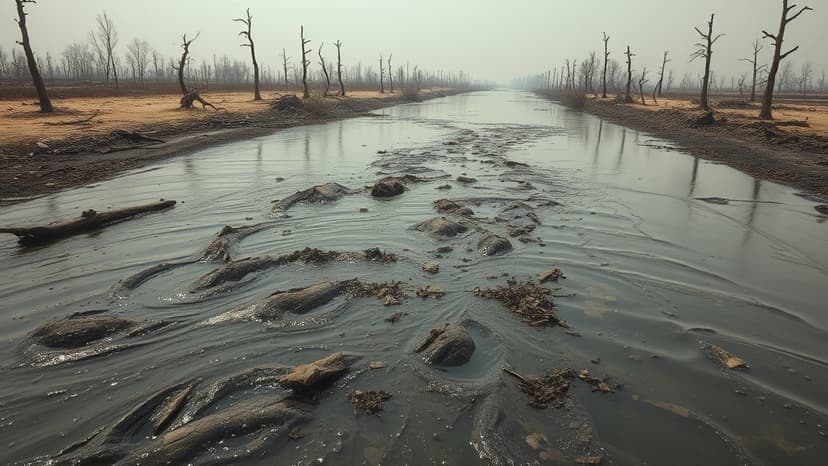
The Central Pollution Control Board (CPCB) has officially acknowledged the severe degradation of five prominent rivers: Satluj, Beas, Ravi, Jhelum, and Chenab. This critical finding was presented in a recent affidavit to the National Green Tribunal (NGT), detailing widespread non-compliance with established water quality standards across numerous monitoring sites.
The Satluj river is particularly affected, with 10 out of 16 monitored locations failing to meet quality benchmarks. Three of these non-compliant sites are situated in Himachal Pradesh, while seven are located within Punjab, including the heavily polluted stretch near Ludhiana's Budda Nullah. The Ravi river also shows issues, with two of its 13 monitored points flagged for non-compliance, one in Punjab and another in Jammu & Kashmir.
Similarly, the Beas river has four of its 41 monitored locations failing to meet standards, with two each in Punjab and Himachal Pradesh. Biological Oxygen Demand (BOD) levels are a primary indicator used by the CPCB to assess organic pollution, categorizing polluted river stretches into five priority classes, with Class I being the most severe.
The NGT's intervention stems from a petition by environmentalist Abhisht Kusum Gupta, who alleges that these five rivers are being systematically destroyed. The petition cites factors such as unregulated industrial discharge from various units, extensive illegal sand mining, riverbank encroachment, unchecked agricultural runoff containing pesticides, and the continuous dumping of untreated municipal waste as key culprits.
In response to these widespread environmental concerns, the CPCB actively manages a National Water Quality Monitoring Programme (NWMP). This comprehensive initiative currently surveys 4,922 locations nationwide, encompassing rivers, lakes, groundwater, and marine environments, to continuously assess water quality.