

Home / Environment / Glaciers Vanishing: Ice Loss Accelerates Dramatically
Glaciers Vanishing: Ice Loss Accelerates Dramatically
13 Apr
Summary
- Global ice loss in 2025 was 408 gigatonnes, four times the late 20th century rate.
- All 19 major glacier regions saw net ice loss for the fourth consecutive year.
- Cascading impacts on sea levels, ecosystems, and freshwater resources are warned.
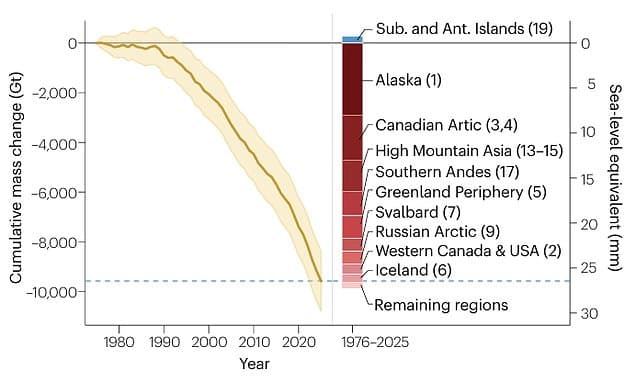
Glaciers worldwide are experiencing unprecedented ice loss, with 408 gigatonnes melting in 2025 alone. This alarming rate is approximately four times higher than observed at the end of the 20th century. The World Glacier Monitoring Service reported that all 19 major glacier regions globally registered net ice loss for the fourth year in a row.
This rapid decline, with six of the most extreme loss years occurring in the past seven years, is reshaping landscapes and contributing significantly to global sea-level rise. While not including continental ice sheets, the study indicates that many glaciers could vanish within decades if warming is not limited.
The largest losses were recorded in regions such as the Alps in Central Europe and British Columbia in Canada. Glaciers in Iceland, Chile, and High Mountain Asia also experienced substantial melt. Scientists emphasize that even stabilizing temperatures won't halt all melting, but every fraction of a degree reduction in warming is crucial.
Separately, Antarctica's Thwaites Glacier, known as the Doomsday Glacier, is facing accelerated melting, potentially leading to an additional 0.5mm of sea level rise annually by 2067. Its collapse could catastrophically affect coastal cities worldwide.

