Home / Environment / China's Desert Blooms: Drones & Tech Fight Sand
China's Desert Blooms: Drones & Tech Fight Sand
13 Mar
Summary
- Modern afforestation uses drones and planting machines.
- China's greening efforts have boosted forest coverage.
- Ecological improvements yield economic benefits like eco-tourism.
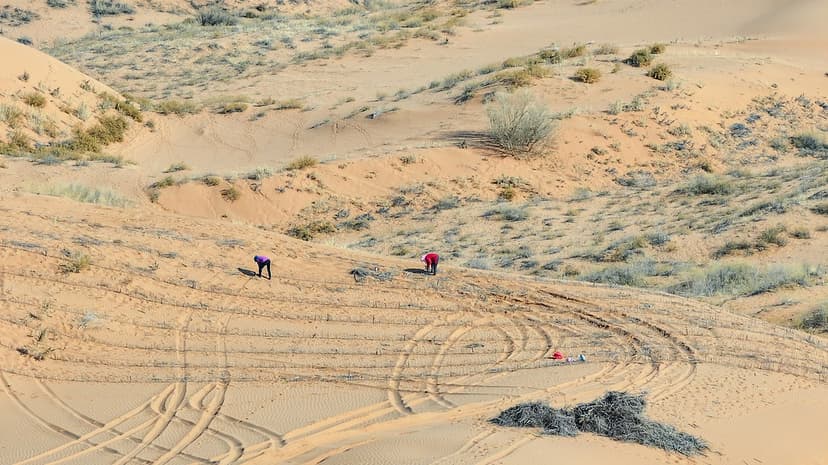
In China's vast sandy regions, farmers like Zhang Zhanjiang are now utilizing advanced technologies, including drones and automated planting machines, to combat desertification. This shift from manual labor marks a new era in afforestation efforts, particularly in Inner Mongolia, where precise data guides planting strategies. These initiatives are part of a larger national campaign to green the country, which has seen forest and grass coverage exceed 56 percent.
The Three-North Shelterbelt Forest Program, launched in 1978, remains a cornerstone of China's commitment to rehabilitating desert-prone lands, with ambitious goals for completion by 2050. Regions like Alshaa League are employing smart equipment, including drones for seeding, to drastically increase vegetation cover and reduce sediment inflow into rivers. Similarly, in the Ningxia Hui autonomous region, efforts are focused on transplanting saplings at optimal times to ensure survival and adaptation.
These extensive greening projects have not only revitalized ecosystems, evidenced by a sharp decrease in sandstorm days and increased vegetation, but have also spurred economic development. Yanchi county, for example, has developed industries based on local shrubs for sheep farming and has seen a rise in eco-tourism, demonstrating the tangible economic benefits of ecological restoration. The country continues to set targets for further land greening, aiming to protect vital water resources from erosion.