

Home / Environment / AI Cams Revolutionize Wind Farm Wildlife Monitoring
AI Cams Revolutionize Wind Farm Wildlife Monitoring
19 Apr
Summary
- AI and cameras track bird and bat activity in real time.
- AI shows birds avoid turbines more than predicted.
- Spoor's technology offers accurate data for decision-making.
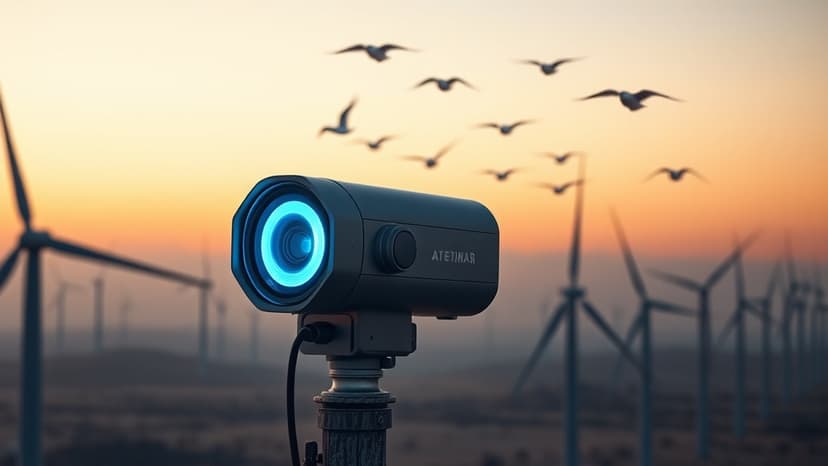
New AI technology from Spoor is set to revolutionize how wind farms monitor wildlife interactions. Traditional methods rely on infrequent human surveys, leading to data gaps and conservative decision-making. Spoor's system uses high-resolution cameras and computer vision to continuously track bird and bat movements around turbines.
This approach generates extensive datasets, offering real-time insights that surpass the limitations of intermittent observations. One significant finding from Spoor's monitoring at Vattenfall's Aberdeen Bay offshore wind farm indicated zero confirmed bird collisions over 19 months, contradicting earlier predictions of approximately 8.5 collisions per turbine annually.
Spoor's technology serves wind energy developers during permitting and operators throughout a project's lifecycle. It provides crucial data for environmental impact assessments and operational adjustments. By offering factual evidence, the system helps avoid unnecessary curtailment and permitting delays.
Beyond wind energy, Spoor's core technology for detecting and classifying airborne activity has potential applications in fields like aviation, transmission lines, and mining. The company's unique selling propositions include a proprietary training dataset, advanced detection range and accuracy, and hardware independence, all protected by patents.
Spoor manages data and compute by processing video on-site using edge computing hardware within turbines. This allows for real-time detection and tracking, with only processed outputs transmitted to their cloud platform. This scalable data layer aims to standardize and compare information across multiple sites, improving industry-wide understanding and decision-making.
This continuous monitoring transforms biodiversity assessment from a project-specific task into an integrated component of the energy system. It enables adaptive management at scale and accelerates regulatory evaluation of new projects, fostering better coexistence between industry and nature.
