
Home / Disasters and Accidents / Dams Fail to Control Floods as Punjab Grapples with Water Mismanagement
Dams Fail to Control Floods as Punjab Grapples with Water Mismanagement
26 Sep, 2025
Summary
- Repeated flooding in Punjab despite dams, due to negligence and greed
- Reservoirs not depleted in time, leading to sudden release of excess water
- Farmers struggle to access their rightful share of canal water
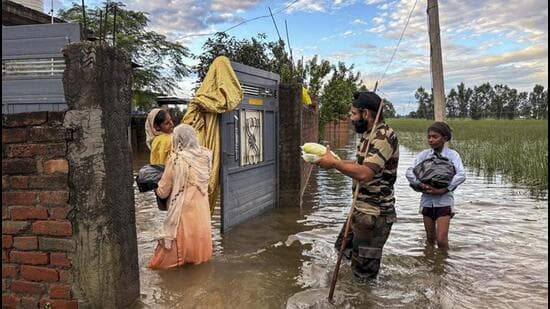
As of September 26, 2025, the state of Punjab in India, known for its abundance of water resources, has been grappling with a recurring issue of devastating floods. Despite the presence of dams built on the state's three major rivers, the region has been hit by severe flooding in 2019, 2023, and now again in 2025.
The root cause of this problem lies in human negligence, greed, and short-sightedness, according to the article. The dams, designed to control floods, generate power, and supply water for irrigation, industry, and domestic use, have failed to fulfill their primary purpose of flood control. Government records show that water flow in Punjab's rivers has been declining over the years, yet the state has been hit by floods, mainly due to the sudden release of excess water from the dams.
The article highlights the case of the Bhakra Dam, whose reservoir has a capacity of 9,621 million cubic metres, with a live storage of 7,191 million cubic metres. Ideally, the dam should be filled during the monsoon and gradually emptied from October, depending on irrigation and power needs. However, Punjab has not been able to use its rightful share of water fully, as Haryana and Rajasthan often use more than their allocated share, while Punjab lags behind.
Furthermore, the article reveals that only 1,852 out of 14,732 villages in Punjab receive canal water, with the remaining 12,880 villages relying on tubewells and hand pumps for their drinking water needs. This is despite the fact that Punjab requires 1.78 million acre-feet (MAF) annually for domestic use. The state's cropping cycle also contributes to the problem, as farmers often abandon their canal turns, particularly at night, and rely on groundwater instead.
The article emphasizes the need for scientific dam management based on weather forecasts, not political compulsions. It also calls for the government to ensure that Punjab uses its rightful share of water fully by building canals, distributaries, and check dams for groundwater recharge and better irrigation. The article also highlights the need to strengthen infrastructure, secure drinking water supply, and ensure environmental flows in rivers, as ordered by the National Green Tribunal.
