feedzop-word-mark-logo
searchLogin
Feedzop
homeFor YouIndiaIndia
You
bookmarksYour BookmarkshashtagYour Topics
Trending
trending

Counterfeit rabies vaccine alert issued

trending

India U19 World Cup squad

trending

Gambhir's fate depends on T20

trending

Jurrien Timber injury unites Arsenal

trending

Nigeria vs Tunisia AFCON match

trending

Juventus faces Pisa Saturday

trending

Kartik Aaryan film earns crores

trending

Spalletti explains Juventus changes

trending

De'Aaron Fox out versus Jazz

Terms of UsePrivacy PolicyAboutJobsPartner With Us

© 2025 Advergame Technologies Pvt. Ltd. ("ATPL"). Gamezop ® & Quizzop ® are registered trademarks of ATPL.

Gamezop is a plug-and-play gaming platform that any app or website can integrate to bring casual gaming for its users. Gamezop also operates Quizzop, a quizzing platform, that digital products can add as a trivia section.

Over 5,000 products from more than 70 countries have integrated Gamezop and Quizzop. These include Amazon, Samsung Internet, Snap, Tata Play, AccuWeather, Paytm, Gulf News, and Branch.

Games and trivia increase user engagement significantly within all kinds of apps and websites, besides opening a new stream of advertising revenue. Gamezop and Quizzop take 30 minutes to integrate and can be used for free: both by the products integrating them and end users

Increase ad revenue and engagement on your app / website with games, quizzes, astrology, and cricket content. Visit: business.gamezop.com

Property Code: 5571

Home / Business and Economy / Mag 7 AI Spending: Overkill or Growth Engine?

Mag 7 AI Spending: Overkill or Growth Engine?

30 Dec

•

Summary

  • Hyperscalers like Microsoft may exceed $100B AI CapEx by 2026.
  • Microsoft's current CapEx is projected at $80B for data centers this year.
  • Meta, Alphabet, and Amazon show rising ROIC, easing spending concerns.
Mag 7 AI Spending: Overkill or Growth Engine?

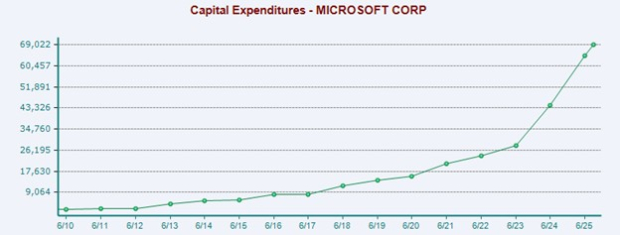
Major tech companies, including Amazon, Alphabet, Meta, and Microsoft, are facing scrutiny over their substantial AI investments. These hyperscalers are constructing vast cloud infrastructures essential for AI and data-intensive services, a necessity for ultimate speed and accuracy. Investors are questioning if this immense capital expenditure, projected to exceed $100 billion annually for AI infrastructure by 2026, is value-destroying.

Microsoft stands out with an estimated $80 billion in data center spending for the current year, significantly boosting its capital expenditures. However, despite elevated spending, Microsoft's return on invested capital (ROIC) has stabilized around 23%. Encouragingly, Meta, Alphabet, and Amazon have reported increases in their ROIC, with Meta at 29%, Alphabet at 31%, and Amazon nearing 20%.

Amazon's profitability shows a marked improvement, bolstered by positive earnings estimate revisions for fiscal years 2025 and 2026. While Alphabet has also seen strong EPS revision uptrends, its stock price has already reflected this growth. The rising ROIC figures for these companies suggest that the market's fears about their significant AI capital expenditures may be overblown for the time being.


Disclaimer: This story has been auto-aggregated and auto-summarised by a computer program. This story has not been edited or created by the Feedzop team.
Microsoft is projected to spend $80 billion on data centers this year for AI infrastructure.
Meta and Alphabet have shown increasing returns on invested capital (ROIC), easing concerns about their AI spending.
Hyperscalers are building massive cloud infrastructures to power AI models and handle huge data workloads efficiently.

Read more news on

Business and Economyside-arrowArtificial Intelligence (AI)side-arrow

You may also like

Google Buys Data Center Powerhouse for AI

23 Dec • 57 reads

article image

Microsoft CEO: AI Race Needs Billions

22 Dec • 58 reads

article image

AI Stocks: Alphabet & Microsoft Eye $5 Trillion

16 Dec • 106 reads

article image

Smart Glasses See 100% Annual Growth

16 Dec • 99 reads

article image

Big Tech Bets Billions on AI, Shifting Risk to Upstarts

15 Dec • 95 reads

article image