
Home / Business and Economy / Gujarat Rail Corridor: Half the Cost, Double the Speed?
Gujarat Rail Corridor: Half the Cost, Double the Speed?
26 May
Summary
- Sarkhej-Dholera corridor construction cost is less than half of Delhi-Meerut RRTS.
- The 220 kmph Gujarat corridor uses broad gauge, unlike standard gauge RRTS and HSR.
- Lower land acquisition and indigenous signaling systems reduce the corridor's cost.
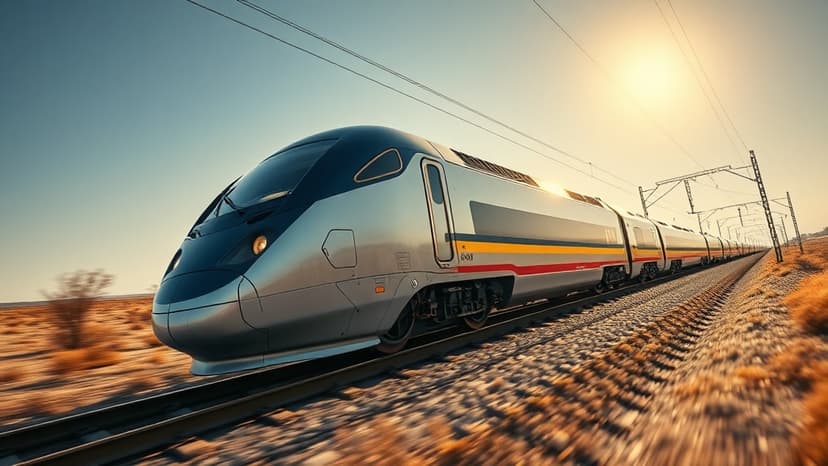
The Indian government has approved the Sarkhej-Dholera semi high-speed rail corridor in Gujarat, a 134-km double-line project designed for speeds up to 220 kmph. This corridor is notably cost-effective, with per-kilometre construction expenses less than half that of the Delhi-Meerut Regional Rapid Transit System (RRTS).
Officials stated that the Sarkhej-Dholera corridor, estimated at Rs 20,667 crore, uses 1676 mm broad gauge, similar to conventional Indian lines. This contrasts with the 1435 mm standard gauge used by the Delhi-Meerut RRTS and the Mumbai-Ahmedabad High-Speed Rail project. The operational speed for the Gujarat corridor is projected at 200 kmph.
Comparatively, the Delhi-Meerut RRTS costs approximately Rs 336 crore per kilometre, while the Mumbai-Ahmedabad High-Speed Rail project is the most expensive at around Rs 358 crore per kilometre. The significantly lower cost for the Sarkhej-Dholera corridor is attributed to factors such as the absence of tunnels, use of the indigenous Kavach automatic train protection system (costing Rs 4.53 crore per kilometre versus ETCS Level-II's Rs 17.74 crore), and reduced land acquisition expenses.
The project aims for an operating speed of 200 kmph, with about 71 km of the 134-km route to be built on viaducts. This initiative represents a more economical approach to developing semi high-speed rail infrastructure in India.
