Home / Arts and Entertainment / Saree's Hidden History: Bengal & Gujarat Fusion
Saree's Hidden History: Bengal & Gujarat Fusion
25 May
Summary
- A recent debate in Bengal centers on saree draping's authenticity.
- Jnanadanandini Devi popularized a structured saree style in the 1870s.
- The modern saree drape evolved from Bengal-Gujarat cultural exchange.
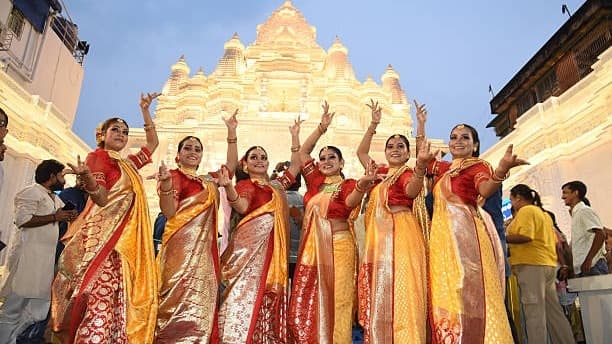
A cultural debate in Bengal concerning the authenticity of saree draping has brought to light the garment's complex history. While some champion the traditional 'aatpoure' style as purely Bengali, its modern form is a product of significant cultural exchange.
The contemporary saree drape, characterized by neat pleats and a pallu over the left shoulder, is a relatively recent development. Its refinement is largely attributed to Jnanadanandini Devi, a woman from the Tagore household.
In the 1870s, while in Bombay, Jnanadanandini Devi observed the practicalities of Gujarati saree draping. Reportedly denied entry into a British club due to her attire, she adapted local styles.
She adopted elements of Gujarati draping, creating a more structured and mobile saree. Upon returning to Calcutta, she further refined this 'Brahmika' or 'Thakurbarir' drape, which allowed women greater ease in public spaces.
This reform-era style significantly influenced how sarees are worn across India today. The common 'Nivi drape' shares structural similarities, tracing its roots to this cross-cultural moment between Bengal and western India, challenging notions of a singular traditional form.


